
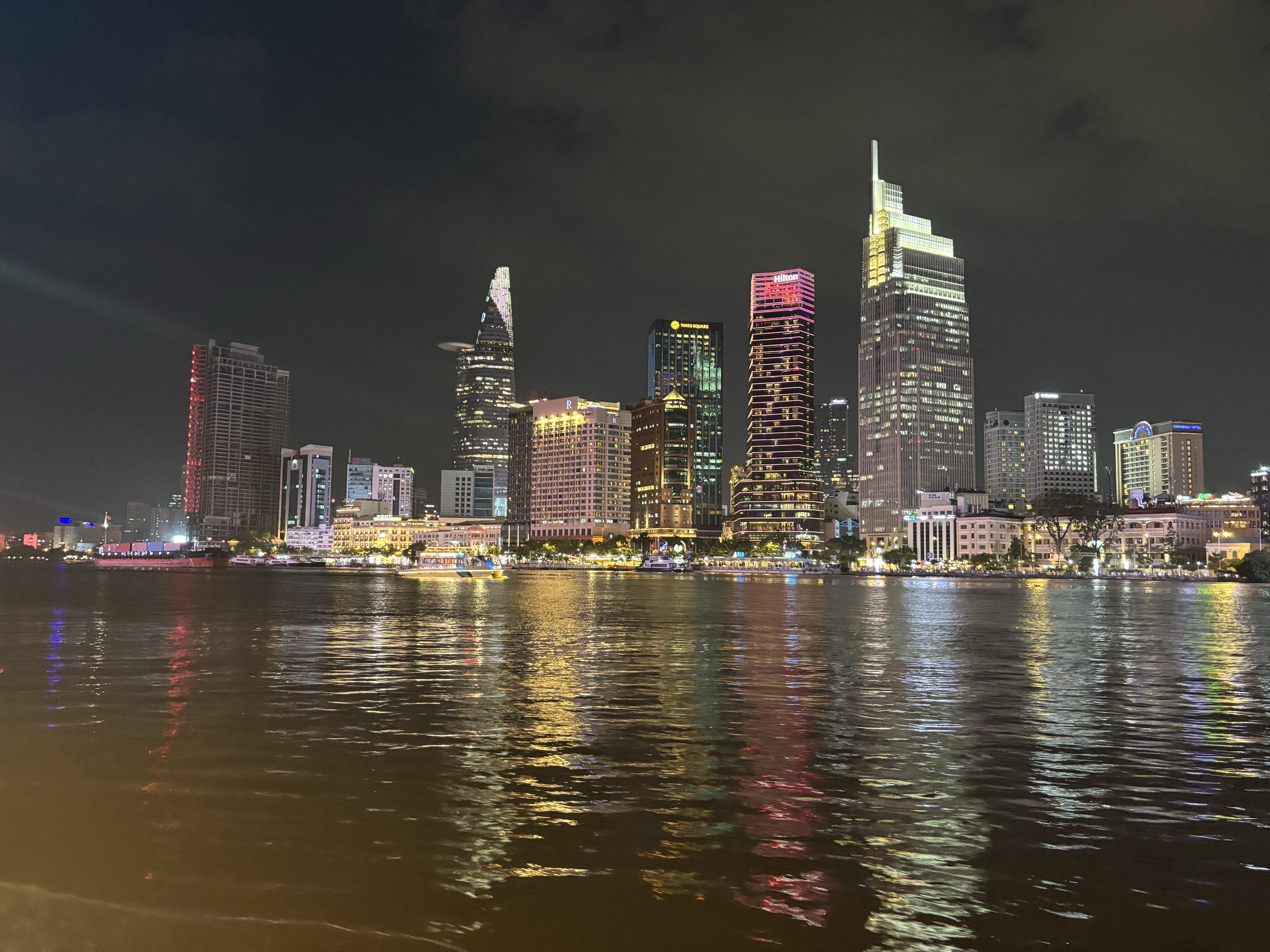
Talk about a change of scenery! After nearly a month in New Zealand, we flew to Vietnam. We went from the fresh air and quiet nature of New Zealand to the chaotic, hot, hazy vibrancy of Saigon. The city was officially named Ho Chi Minh City after the American (Vietnam) War, however, most locals still call it Saigon. With nearly ten million people, Saigon is now a dynamic, cosmopolitan city where old, new and everything in between create a tapestry of interesting sights.


Looking out the window of our modern boutique hotel, we could see colonial buildings with tile roofs, next to tin-roofed shanties next to a concrete apartment building. There were air conditioning units and electric lines everywhere, an old bidet and broken toilet on one of the tin roofs, some bougainvillea-filled rooftop balconies of homes with laundry on lines, and the courtyard of a school across the street.
On our first morning there which happened to be a Monday, we heard the school kids sing the national anthem (which they do every Monday morning, lucky us!) at their assembly. We watched it all happen as a procession of parents on scooters dropped kids off for school in their matching uniforms. It wasn’t unusual to see a toddler or even baby on the scooter waiting for mom or dad to drop off their brothers and sisters.
There was also a very different looking building across the street and we asked the hotel staff what it was. We learned it is the house of Ngoc Son, a famous Vietnamese singer who designed it and wrote some of his lyrics on the outside walls.


Our hotel was in a good location to walk to a lot of the city landmarks. On our first morning we walked through several parks making our way to the Reunification Palace. There were some ladies doing Tai Chi and other exercises in the park as we walked through. The flowers and displays were interesting. Like in most parts of the city, many things looked a little run down, but there were glimmers of beauty here and there – like the beautiful lotus flowers, and lots of decorations wishing people a happy new year.


Vietnam was a French colony for nearly 70 years from 1887 to 1954, as part of French Indochina, which also included Cambodia and Laos. The French lost control of Indochina after the Battle of Dien Bien Phu in 1954. The Geneva Accords in 1954 divided Vietnam into North and South, with the communist Viet Minh controlling the north and the French transferring authority in the south.
We walked by the Reunification Palace – an important spot for Vietnam history, as it was where the war ended in 1975 when the Northern Vietnamese tanks breached the gates and the South surrendered unconditionally. It was built in the 1960s as the headquarters for South Vietnam. Prior to that, it was the site of a more elegant palace built by the French in 1858.

Our next stop was another French Colonial landmark, the Notre Dame cathedral – built in 1880. Unfortunately it was undergoing extensive renovations and we couldn’t see the building at all. But we did admire the old pictures shown across the enclosure walls. Across the street was the old post office, built in 1891 also by the French. It was originally known as the Saigon Telegraph-wire Department and maintains much of its old charm inside, including banks of phone booths with clocks showing the time in different parts of the world.


From there we wandered down to the expansive Nguyen Hue boulevard where a statue of Ho Chi Minh stands impressively at the top, with a beautiful palace behind him. Ho Chi Minh led the effort for independence from France and became the country’s first communist leader after reunification. This area was one of the ritziest in the city, with luxury brand stores like Cartier, Rolex and Chanel lining the streets. A bit ironic. This was also where the Opera house was.


By this time we were feeling the effects of the heat – getting hot, sweaty and a little dehydrated. After stopping for some refreshing cold drinks (calamansi iced tea and guava/peach lemonade), we headed to the famous Bén Thành market. This large covered market was built in 1914 and is a veritable labyrinth inside. Today, the market primarily serves tourists (both domestic and foreign) and is loaded with everything you could imagine – including extensive brand knock-offs. We did not feel like shopping so we buzzed through a few aisles and went back to our hotel through some interesting alleys to rest and freshen up.


One of the highlights of our visit to Saigon was a private food tour via scooter on our first night there. We chose a street food tour company that only employs women as an effort to empower them. Our young tour guides Xinh and Nam were delightful, and they were wearing the traditional Áo dài (a modernized Vietnamese national garment consisting of a long split tunic worn over silk trousers). They shared some of their experiences growing up in the countryside where it is still desired to have boys versus girls, and how they moved to a bigger city for their studies, stayed to work and be more independent.
They were excellent scooter drivers (learning as young as 11) and they scootered us to some authentic street food areas of the city (away from the tourist centers). It was fun (and a little hair-raising) to join the non-ending stream of motorbikes and cars on a scooter… It looked like complete chaos with traffic coming at you from all directions, however amazingly it all seemed to work! Luckily, everyone drives pretty slow and tactically avoids hitting each other and the pedestrians who bravely cross the streets. Experiencing a left turn across a zillion lanes of traffic is quite the thrill.


We tried twelve different foods and drinks on our tour. We have found Vietnamese food to be one of our favorite cuisines in the world. The flavors are so fresh, tangy and textured. The street food we tried on the tour reinforced our opinions.
Apartments in the city are small and crowded, many generations living together. Many do not have kitchens, so most people eat all their meals out. They also eat at any time of the day or night – usually smaller meals or snacks. In the evenings after work, the sidewalks and streets become social centers with friends and families sitting on the small stools or even on the ground enjoying their food and drinks until late in the night. It is truly amazing to see the variety and quantity of food options in the streets.


Sophie’s favorites were the banana crackers and the Nuoc Mía (sugar cane juice). We also ate a soup we really liked from the Hué region (Bún Bò Hué) and the famous Bánh Mí sandwiches. The Vietnamese kept the bread tradition brought by the French and made smaller baguette loaves for the Bánh Mí. We also tried fresh spring rolls wrapped in rice paper (Goi Cuon), a baked quail egg dish, some savory little pancakes, the Vietnamese version of pizza and some barbecued skewers, washing it all down with Saigon beer, and ending the night with Vietnamese flan.


We saw lots of unfamiliar foods while going through the night markets, and our tour guides also took us to a flower market that runs 24/7. Beautiful arrangements were made for weddings, funerals (white arrangements) and offerings. They told us that each family has an altar in their house where they honor their ancestors with fresh flowers.


We also visited a monument for a monk, erected in the street where he died. Thích Quảng Đức was a Vietnamese Mahayana Buddhist monk who died by self-immolation at a busy Saigon road intersection on 11 June 1963. He was protesting the persecution of Buddhists by the South Vietnamese government with a Catholic in power at the time. Photographs of his self-immolation circulated around the world, drawing attention to the persecution. John F. Kennedy said of one photograph, “No news picture in history has generated so much emotion around the world as that one”. The Vietnamese people continue to admire and honor him everyday.


The next day, we visited some of the more modern parts of the city, including the Skydeck in one of the financial towers called the Bitexco Financial Tower. This gave us good (albeit hazy) views of the massive city, along with a much needed bit of air conditioning.
The Bitexco building is shaped like a lotus flower bud. The lotus flower is considered the national flower of Vietnam and has a special position in Vietnamese life and culture, representing the beauty of the Vietnamese soul. The Vietnamese people identify with the optimistic outlook of the flower which can adapt easily to any situation while purifying the water where it grows. There was also a very interesting exhibit on the traditional Ao Dai Vietnamese dresses showing how they have changed over the years. They are so beautiful.


In the evening, we took a water bus on the river making an ad hoc sunset cruise. We thought this might be a good way to see some further flung areas of the city. There were some massive, modern apartment blocks in some areas – one must have had ten thousand units! At night, many of the modern buildings came to life with lights.


After the cruise, we stumbled across an interesting building called an Apartment Café. It was an old apartment building repurposed into small shops, spas, bars, cafés and restaurants. It was too interesting to pass up, so we entered making our way to the back through a sea of scooters. We climbed the stairs to explore each floor and ended up eating in a tiny café called Madam Quyên. Their specialty was Bánh Xèo, a savory pancake resembling a crêpe that you rolled up in lettuce, shiso leaves and rice paper, and then dipped in sauce. It was delicious. We washed it down with some local Saigon beer. It was a perfect end to our day.


We really enjoyed our hotel (Fusion Suites Saigon), it had a fun atmosphere and our suite was very nice. We had breakfast at the hotel every morning, which tied us till supper. The buffet breakfast was serving about a dozen different Vietnamese hot foods each morning (along with tropical fruits, juices and western cold breakfast choices), and you could also order pho. I tried a small amount of each food each morning, and loved everything.


But the best thing was the Vietnamese milk coffee. It is a very strong brew of locally grown Robusta coffee sweetened with condensed milk. It has such a strong, yet sweet, coffee flavor. I think it is becoming my favorite coffee. The coffee culture is very strong in Vietnam, with many different hot or iced coffee concoctions. Vietnam is the world’s second-largest coffee exporter and the world’s leading producer of Robusta coffee, which accounts for a significant portion of its coffee. We had tried egg coffee (with a frothed egg yolk) a couple years ago in Hanoï and that was also very delicious.
After three nights in Saigon, we are off to Hué – an ancient capital in the mountains further north.


Leave a Reply