
It was mid-November and we were not ready to give up on camping yet, so we headed south thinking we would visit the Ozarks. We were gone 9 days, spending most of our time in both southern Missouri and Northwest Arkansas. We have to say we were especially impressed with the landscape and hiking in Arkansas – and would definitely visit again.
Before getting to Arkansas, we drove through Missouri, starting in the northeast side of the state. After spending our first night in a sketchy campground in northern Missouri on US63, we continued our trip towards the Lake of the Ozark area. Before getting to our next campground, we enjoyed driving through the countryside on lots of roads that felt like roller coasters, going up and down endlessly.


Our next campground was in Camdenton, MO, where we visited the oddly named Ha Ha Tonka State Park. The name wasn’t the only thing unusual about this park: it featured some unique geology and abandoned European-style castle ruins high on a hill. The Ha Ha Tonka name comes from the Osage Native Americans who called the prolific spring there “laughing waters.” The spring pumps out millions of gallons of water per day, which today flows into the massive Lake of the Ozarks reservoir.
Back in 1903, before the dam existed, a wealthy Kansas City businessman named Robert Snyder purchased over 5000 acres of bluff overlooking the spring with a dream of building his private retreat, a European-style castle with 60 rooms, a water tower, greenhouses and stables. The materials were extracted from the area, with sandstone quarried nearby and transported by a mule-drawn wagon and miniature railroad. Construction began in 1905 but was halted a year later when he died in a one of the state’s first auto accident. His sons worked to complete the castle and finished the structure in 1922. Amidst legal and financial problems, it was not as elaborate as originally planned. It was eventually leased out as a hotel and lodge until a fire destroyed it in 1942. The state purchased the land and ruins in 1978 and turned the whole area into a park.
The views from the ruins were incredible – and one can only imagine how fabulous it would have been to stay there when the castle was in its prime. In addition to the main castle, there was a carriage house that also burned, and a beautiful water tower (where the caretaker lived with his family). The tower was restored and stands proudly high atop a hill – a testament to the estate’s former glory.


After exploring the ruins, we continued hiking in Ha Ha Tonka State Park down to the lake and up around the ridges. There were many beautiful views and geological wonders created by the dissolving action of water on the karst bedrock – including a massive natural arch bridge that is 70 feet wide, spans 60 feet and reaches more than 100 feet in the air. After passing beneath the natural bridge the trail descended into a theater-like sinkhole formed by the collapse of a giant cavern. There were many caves nearby rumored to have served as hideouts for criminals in the 1830s.


The next day we jumped on famous Route 66 for a little while heading towards Springfield. I-44 runs right alongside Route 66 much off the way, which proved to be a more efficient route after a while.
Just before Springfield, we stopped for gas at our first Buc-ee’s gas station. We had heard about Buc-ee’s before but didn’t known too much about it. It had over 100 gas pumps almost all in use – which makes sense since their gas was 30 cents cheaper than anything around. It was quite an experience, and inside the station it was almost like a theme park gift shop/convenience store with freshly baked goods and meats. We bought a few groceries and shared a smoked brisket sandwich for supper later that day – it was admittedly delicious! From Springfield we headed south to Branson, MO.


Our next campground for 3 nights was at Table Rock State Park, just outside of Branson. Before it got too dark, we took a walk along the shore of Table Rock Lake to the dam that made it. The lake is massive as it fills in many, many valleys far along what was once the White River. There is supposedly as much lake shore here as the entire coast of California! Some areas were all decorated for the holidays, which felt a little weird to us since it was so warm out! We ate supper outside and enjoyed the night sky.


The next day we explored the touristy city of Branson. You can find every imaginable tourist trap in Branson – from a recreation of the Titanic to Ripley’s Believe or Not, to an upside down Mansion, to Dolly Parton’s Stampede musical on horseback – which as it was the beginning of the holiday season, featured the three wisemen on the back of real camels…
The only shows that interested us were sold out, so we spent most of our time in the historic area of town. We noticed lots of families walking around in pyjamas. We thought this was odd, until we saw that the Branson Express historic train ride had been rebranded “The Polar Express” for the holidays. The highlight for us was eating an excellent rack of ribs at Full Throttle Distillery. We really love the dry-rubbed St. Louis style ribs!


On our last day in this area, we drove to Dogwood Canyon, a beautiful nature park nestled in the Ozark Mountains and created by the founder of Bass Pro Shops, Johnny Morris. The park winds its way up a valley criss-crossing a picturesque creek where we spotted lots of trout.
There were dozens of beautiful handcrafted bridges, along with some impressive buildings that kept the historic look of the Ozarks. We walked over seven miles to the end of the canyon and back, taking a few side-trails as well. Towards the end of the trail, we actually crossed the border into Arkansas, which was kind of neat. We were glad we visited this picturesque park on a very nice autumn day.


Our next destination took us deeper and higher into the Ozark mountains, in Northwest Arkansas. We first stopped at a super welcoming welcome center in Harrison, to get some information about the area. We learned that Arkansas is called the natural state, to reflect its diverse scenery of mountains, lakes, rivers, and forests. That name was adopted in the 1990s to promote tourism and its outdoor beauty. And from what we discovered during our stay we agree with that slogan.

During our stay in Northwestern Arkansas, we camped at a stunning, hilltop campsite near the little settlement of Ponca. The view out our camper windows was like a painting. It featured an old barn with a backdrop of a wooded, undulating valley. This area is part of the Buffalo National River – a federally protected area preserving one of the last natural (not dammed) rivers in the region.


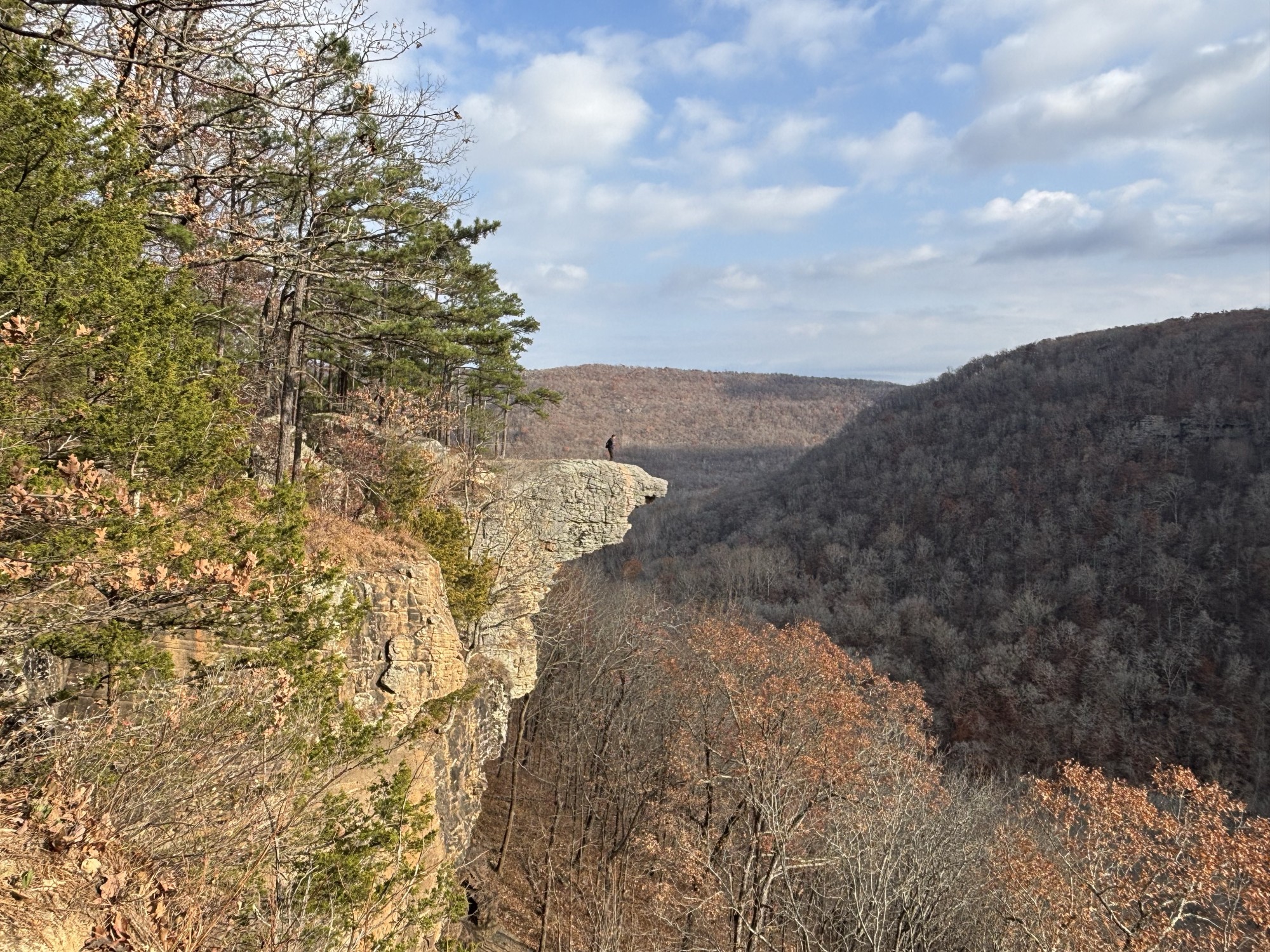
After dropping the camper off, we headed to one of the most popular hikes in the area: Hawksbill Crag or Whitaker Point. To reach the trailhead, we had to drive up Cave Mountain Road, a steep dirt road and follow a ridgeline for about six miles. I thought the drive was great fun – I am not sure Sophie agreed. She did agree, though, that the payoff at the end of the hike was worth the drive. The hike was about three miles round-trip and led to the top of an impressive cliff face with fun stacked-rock formations. The most famous view is of Hawksbill Crag which juts out high above the valley, it is one of the most photographed points in Arkansas.


We finished the hike in good time, so we decided to take another hike closer to Ponca called Lost Valley Trail. This was another pretty cool hike that followed a stream that alternated between underground and overground. In one spot, the stream went through a tunnel through a large rock face. On the other side of the tunnel was another valley full of large boulders (the hidden valley). Following it further up revealed a massive cavern in the side of the bluff called Cobb Cave. Artifacts like baskets, textiles and gourds were found there along with weapons. Archeologists believe the cave was used as a shelter and storage site as far back as 2000 years ago or more. Because the cave was extremely dry, the artifacts were better preserved – including a bunch of corn cobs which gave the cave its name.
The valley ended at Eden Falls, a 53-foot waterfall. We only saw a trickle, though – as it hadn’t rained for a while. Further up, the waterfall actually runs through a cave that you can climb into. Because it was getting dark as it was close to sunset, we ended up skipping that part and hiking back.


The following morning we embarked on a longer hike closer to our campground. It was called the Centerpoint trail and led to the Big Bluff Goat Trail. This hike went downhill most of the way in, making it a more challenging uphill slog on the way back. The highlight was the “goat trail” at the end that hugged the edge of a bluff cliff. It was really fun, but you wouldn’t want to be scared of heights. At one point you had to crawl through a small hole in the cliff face to continue to the next section. And at another point, you had to kind of swing yourself around an ancient juniper tree to keep going.
Some of the junipers growing out of the rocks there were 800 years old! Their twisty bark and branches had so much character – we loved them. We were also surprised to discover American beautyberry bushes. They provided an extraordinarily brilliant pop of purple color in the brown fall landscape. The views were amazing and the weather so beautiful, we really lucked out! This was one of our favorite hikes on this trip.


We headed back to our camper for lunch then decided to explore the surrounding valleys by car. We started at the Boxley Valley district historic home, and continued with a pioneer farmstead just outside of Ponca. It belonged to “Beaver Jim” Villines, who grew up here. The old cabin, barn, smokehouse and more were still standing – letting you imagine what life here may have been like in the late 1800s.


Next we drove on a very windy road to Jasper – a quaint mountain town. Above the town was the generously named “Grand Canyon of Arkansas” which we stopped to look at. We then headed back down to Jasper to explore some of the little shops. We decided to eat at the historic Ozark Café – a highly rated restaurant that has been open for over 116 years!
They had some fun things on the menu that we just had to try. I ordered the Excalibur burger, which consisted of a hamburger served between two grilled cheese sandwiches held together by an excalibur-like knife! (Blew my mind.) Sophie ordered the fried catfish platter, which came with hush puppies, a baked potato and a side of beans. They are also famous for their Chocolate Gravy, but it is unfortunately only served at breakfast while supplies last – and supplies never last.


It was getting dark by the time we got back to Ponca, but we stopped along the Box Valley anyway to check for Elk. A large herd of Elk lives in the valley and you can often see them from the road near town. We were lucky to see one running along the field, but we did not see the herd.


The next morning we decided to start the road back home. Some storms were headed to the area and we thought it was best to avoid them. We stopped for a picnic lunch at the Crystal Bridges Museum of American Art, in nearby Bentonville. Bentonville is the headquarters of Walmart. The Walton family and heirs are incredible benefactors for the community, which included building this amazing museum complex which is still in progress.
The museum interweaves with the natural landscape to create an interesting space for art – some outside, some inside. We enjoyed seeing some contemporary art by artists we didn’t know – as well as some pieces from very famous artists like Norman Rockwell, Georgia O’Keefe and Grandma Moses, and also the glass blowing artist Chihuly. We were delighted to find an outdoor display featuring some of Yayoi Kusama Flowers. She is a Japanese artist we recently discovered thanks to our daughter, and she uses polka dots in a very fun way. As they continue to build out the museum more, it is going to become quite a midwest gem!


After camping overnight in Bethany, MO, just south of the Iowa border, we drove home the next day. We got back just in time to enjoy the last couple days of nice November weather, so we could winterize our camper and clean up the yard. Three days later temps plummeted and winter arrived with a blanket of snow. Camping season was officially done for 2025; it was a good one!


Leave a Reply