
We found a great deal on Icelandair to fly from Minneapolis to Brussels just after Thanksgiving. We had planned to stay two nights in Brussels, then fly to France to spend ten days with Sophie’s parents before Christmas. Unfortunately, our flight out of Minneapolis was delayed due to winter storms and we missed our connecting flight in Reykjavik to Brussels. Since Icelandair doesn’t fly direct to Brussels every day, we ended up getting booked on flights to Helsinki then Brussels the following day. By the time we arrived in Brussels, it was too late for any sightseeing before our flight to Toulouse the next morning. But, on our way back home, we were able to briefly visit the city for one afternoon/evening. We loved it – and thought it was worth a quick blog post.
Brussels center is easily accessible from the airport by train, taking just 20 minutes to arrive in the heart of the city. Our comfortable hotel, Numa, was conveniently located only a few minutes’ walk from the central train station, offering the perfect base for exploring the vibrant city center filled with stunning architecture and lively streets.


Across the street was an entrance to the Galeries Royales St. Hubert – a beautiful covered shopping mall that dates back to 1847. It was one of the first glass-covered shopping malls in Europe, and it inspired shopping galleries in Paris, London, and beyond. Built in an age of expansion and industrialization, it featured trendy shops, theaters and cafés on the ground floor with elegant apartments above – a very efficient modern living concept. The residents could go to the theater or a café without having to muddy their shoes – quite revolutionary at the time!
Today, the stores are much the same as they were – with several chocolate shops, cafés and exquisite boutiques – all unique, no chain stores there. Each store specializes in one item – like hats, gloves, lace, umbrellas, etc. – generally handmade on the premises. Everything was beautifully decorated for the holidays.


The famous chocolate brand Neuhaus got its start in 1857 at its flagship store in the Galeries St. Hubert. Having arrived in Brussels from his native Switzerland, Jean Neuhaus opened an apothecary shop. To make the bitter medicines he sold taste better, he coated them in chocolate. In 1912 his grandson Jean Neuhaus II took this idea further by inventing the Belgian praline, a decadent chocolate cream ganache center inside a chocolate shell. Pralines were immediately successful, soon to be followed by another innovation by Louise Agostini, Jean’s wife in 1915. She developed and patented the ballotin, a gift box preventing the chocolates from being crushed.
Other iconic chocolate shops got their start in Brussels as well. Belgians take their chocolate seriously, and rightly so: it is an essential -and delicious- part of their economy. You may have heard about Godiva (now owned by a Turkish company but founded in Belgium in 1926) or Mary (founded in 1919 by the first woman chocolatier Mary Delluc and purveyor of chocolates for the royal family).
There are many other chocolate stores like Galler, Cornet, Leonidas or Pierre Marcolini (an avant-garde chocolatier), to name a few. We had to do some research on the topic and gladly visited several of these chocolate boutiques. We marveled at the elaborate displays, enjoyed the samples and bought some delicious chocolates to bring back home.


One of the streets nearby the Galeries St. Hubert is Rue des Bouchers (butchers street). It dates back to the Middle Ages, and was originally home to butchers, hence the name. This narrow historic street is famous for its dense concentration of restaurants, cafés, and bars, and is often called “the belly of Brussels”.


Down this charismatic street are some fantastic restaurants and pubs, including the legendary Chez Léon, founded in 1893. Chez Léon is famous for its mussels and fries—a must-have when in Belgium. The restaurant has maintained its traditional recipes, making it a popular spot for delicious seafood. We ate supper at Chez Léon and both got the “Moules Frites” special that included steamed mussels, fries, and refreshing Belgium beer. The mussels were deliciously prepared and went perfectly with the beer. We love mussels and fries!


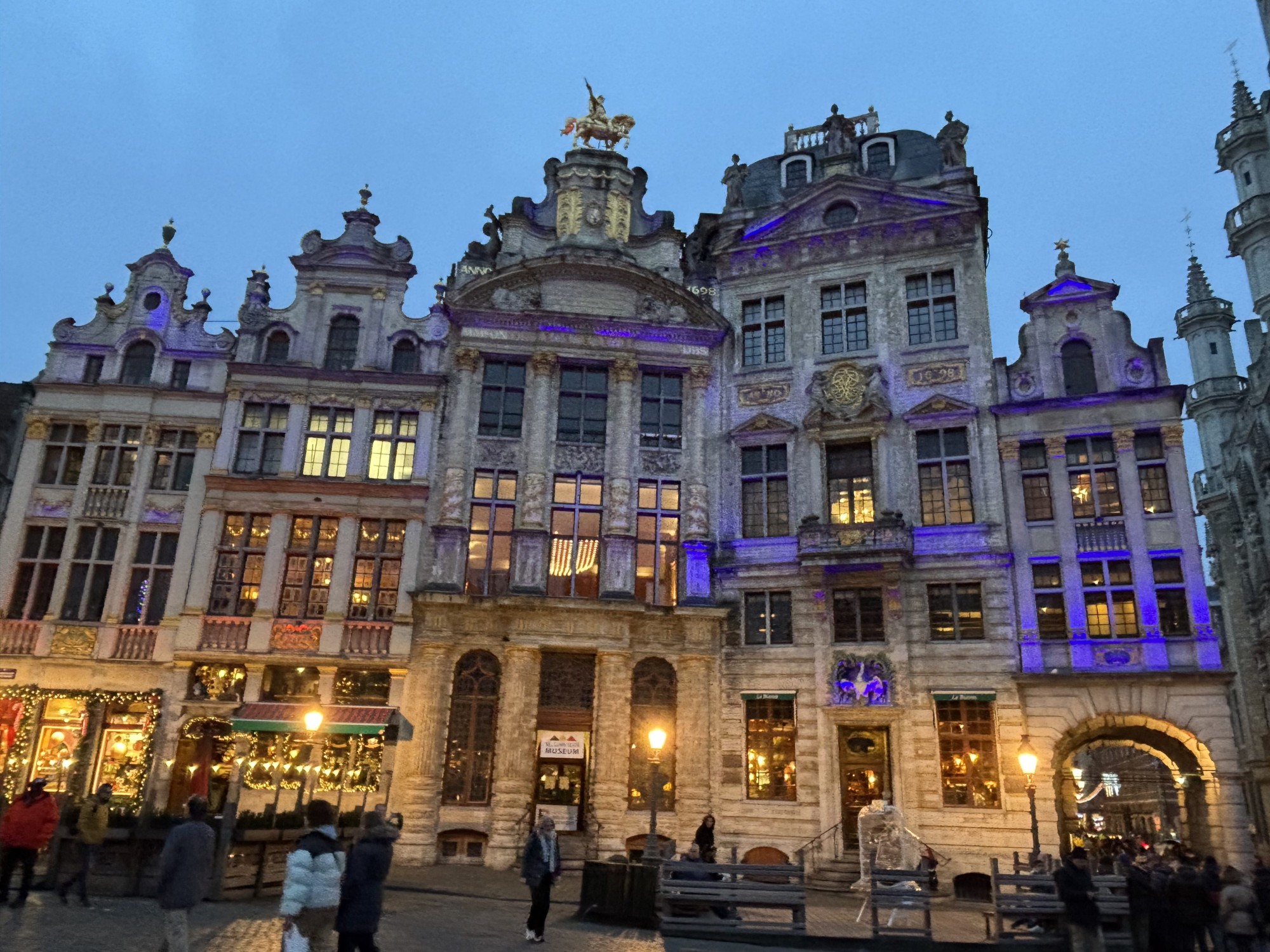
On the other side of the Galeries Royales St. Hubert is the magnificent Grand Place, the heart of the old town and the city’s greatest sight. La Grand Place is Brussels’ main square which started as a market for a small village in the medieval times. The Grand Place was beautifully decorated for Christmas, featuring a large tree in the center, adorned with sparkling ornaments and lights that created a warm ambiance.
Surrounding the square are impressive buildings, including the dominant and oldest Town Hall. While it was built in the 1400s in Gothic style, the statues and ornamentation were added in the 1800s. The grand tower, which dates from 1455, is topped with St. Michael, patron and protector of the city.


Opposite of the Town Hall is the King’s House. The structure has gone through several incarnations in its 800-year history. It was first the medieval square’s bread market, then in the early 1500s it became the regional office for the empire of Charles V, hence its name. But its lacy facade dates from the late 1800s, when it was renovated to be the City Museum.
Both were lit up with colorful lights that danced to music at certain times during the evening, attracting many visitors eager to enjoy the holiday spirit.


Along another side are some fancier smaller buildings that give the square its unique character. These charming tall merchant houses, were rebuilt by wealthy merchants after the Nine Year’s War. During that war in 1695, French King Louis XIV’s troops leveled everything around the Town Hall in an attempt to destroy that building. The “bombardement of Brussels” was the most destructive event in the city history, with 4,000 mostly wooden buildings destroyed.
After this devastating event – and as a matter of pride- Brussels’s brewers, bakers, corkscrew makers, etc, rebuilt their offices better than ever. Everything was completed within seven years, in stone, taller and topped with ornamental gables and classical statues. Some of these lavish buildings were even trimmed with gold.


The entire square was restored in 2014, and it looked spectacular! We were completely surrounded by centuries-old buildings and immersed in historic ambience, it was quite an experience. We ended up coming back to admire the Grand Place several times throughout the evening.


The Brussels Christmas Market was in full swing when we visited Brussels. It is spread out across several of the squares and parkways in the town center, so it took us some walking to discover where everything was. The markets were filled with wooden chalets that sold all sorts of handmade foods, textiles, and crafts. As we got closer to the ancient church of Saint Catherine, there were more food and beverage stalls selling mulled wine, hot chocolate, waffles, and all sorts of seasonal foods and candies.
It was quite crowded and festive there, with what looked like mostly locals enjoying an evening out eating and drinking with friends. We were lucky with the weather – it was not raining with temps in the comfortable upper 40s.


Belgium is not only well-known for its chocolate, waffles and beer, but also for its comics culture. Some of the most-loved European comic book characters like The Smurfs (les Schtroumpfs in French), Tintin and Lucky Luke were created in Belgium. “Les Aventures de Tintin” was one of Sophie’s favorite comic book series when she was growing up. She collected and still has every book. Tintin was a reporter/adventurer who traveled the world solving mysteries, and he helped shape Sophie’s love of travel and adventure.
While the official Tintin museum was out of town and too far for us this time, we did stop at a small boutique that had lots of Tintin merchandise and memorabilia from the different comics. Sophie was really happy to be immersed in all of that again, and she bought a few things. We also saw a famous mural depicting him in a nearby street and some pieces from the stories throughout Brussels.


Finally, every tourist apparently must see Manneken-Pis, the statue of a little boy peeing into a fountain, which has become an iconic symbol of Brussels’ irreverent sense of humor and charm. He gets dressed up in different costumes regularly, with outfits changing to reflect holidays, special events, or even national celebrations. This beloved statue, created in 1619, is so popular that nearly every tourist store prominently features him on everything from magnets to bottle openers, clothing, and even chocolates and waffles. It is actually a very small statue.
We also saw a more recent sculpture called Jeanneke-Pis, squatting just off Rue des Bouchers. Created in 1985, this pigtailed female is the counterpart of Manneken-Pis and shows a little girl peeing. It has been introduced to provide equal opportunity representation for the sexes.


We had a great time wandering throughout this small part of the city, and we really enjoyed our short visit to Brussels. We would love to come back to explore more of this beautiful and vibrant city.


Leave a Reply