
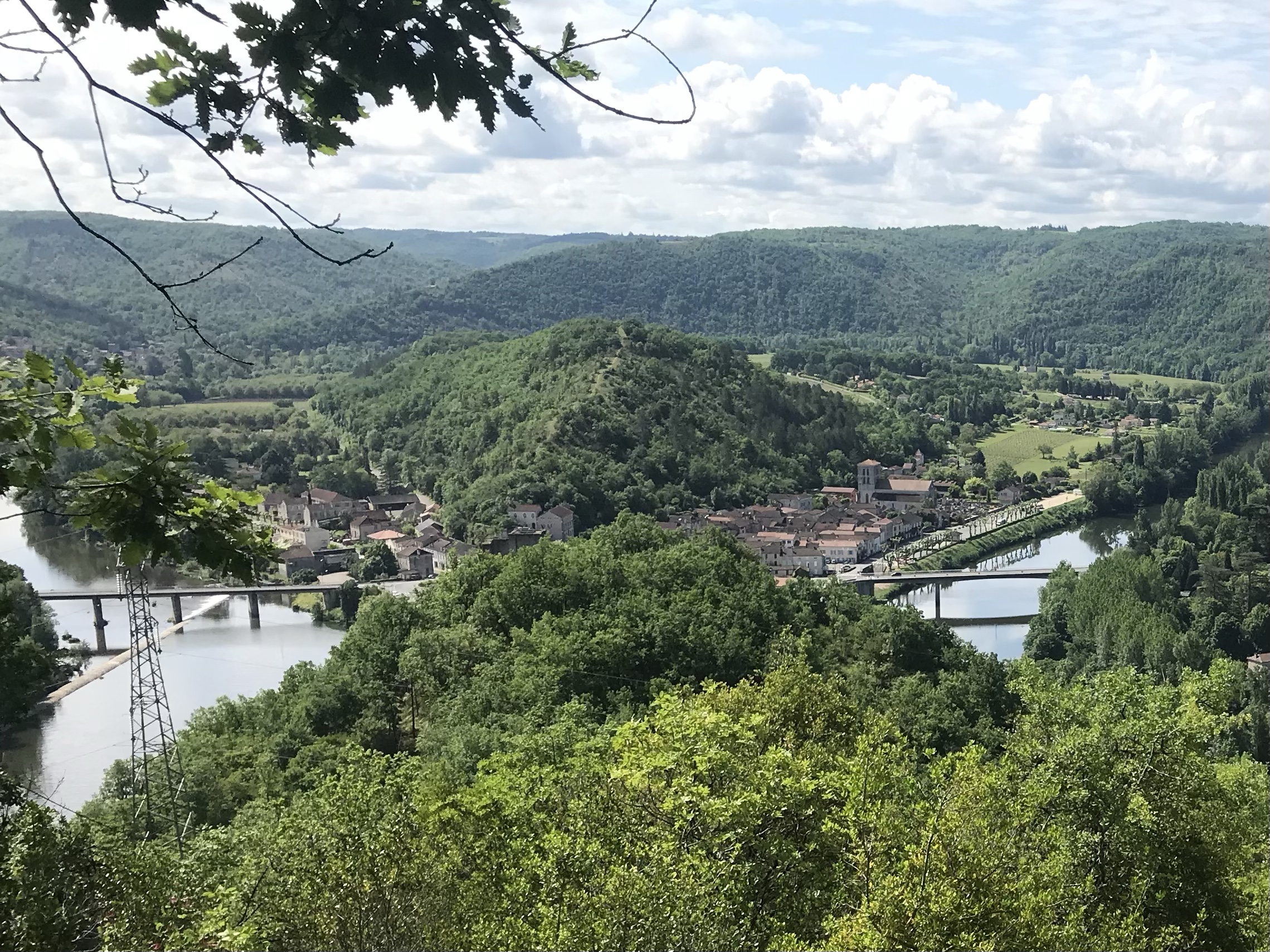
The village of Luzech is Sophie’s “hometown” and where her parents live. Around 1,800 people live in Luzech today, but it has been inhabited since prehistoric times. Its most iconic feature is a square tower, the remains of an 11th century castle, that rises above the town at the base of a steep hill. At the top of the hill are the ruins of an oppidum (a fortified settlement) that comes from the Gallo-Roman period. During the middle ages, Luzech was surrounded by a fortified wall. You can see some remains of the wall and its seven gates around the town. The castle and town were subject to many conflicts over the centuries, including being sieged then occupied by Richard the Lionheart, King of England in 1188, before being looted and burned by crusaders in 1212.


The village was built between a large buckle in the river Lot, a strategic spot on this important waterway. Between 1840 and 1950, a canal with a lock went through the center of the town so boats and barges could short-circuit a particularly treacherous loop of the river about 3 miles long. Commercial river traffic had largely stopped by the early 1900s with the building of train lines, and the canal was eventually filled in by 1950 to create a new town square.
South of town within the loop of the river is the chapel of Notre-Dame de L’Ile, built in 1504. This picturesque chapel, surrounded by vineyards and the river, was dedicated to the safety of the boatmen navigating the dangerous section of river here. This is where Sophie and I got married in 1995.


There is an impressive railroad bridge and subsequent tunnel running behind the town that were completed in 1869, part of a rail line running all along the Lot river. The tracks were last used in the 1960s when a street car the locals called “The Micheline” would haul passengers along the line to Cahors. The Luzech stop was on top of the bridge, and Sophie’s mom remembers taking it when she went away for school to become a dress maker. Last year a 7-mile portion of the line between Luzech and Mercuès was converted to a paved bike path. This was a dream come true for me, and I hope that the rest of the line eventually is converted as it is so picturesque! The bridge and tunnel have not been converted yet, but the path is kept clean and you can walk across the bridge and through the tunnel so I have hope!


One thing I love about France is that there are hiking trails everywhere. There are national routes that criss-cross the entire country, as well as numerous local trails maintained by communities and volunteers. GR36 is a 75-mile national trail that goes right by Luzech, and there are dozens of other trails to explore that take you along steep ridges, down through moss-covered valleys and through lush forests. Walking clubs are very popular here – particularly with retired folks. The clubs explore the local trails, take trips to other parts of France, and have a lot of group meals together. Sophie’s parents belonged to several of these clubs over the years. The pictures here are all from walks around Luzech. The diversity of terrain is great.


You may notice a lot of old stone walls and small stone huts (called gariottes) in the pictures above. These are everywhere in the woods and hillsides and for years intrigued me. Why did they build so many walls? There seemed no rhyme or reason for where they were. I finally discovered the answer when I was asking Sophie’s dad about the origins of his large garden behind his house. I asked him what the terrain looked like before he created the terraced garden. He said it was all rocks and that he spent two full years digging rocks out of the soil by hand. He said that’s what he used to build all the walls in the garden. So, there was my answer. People living off the land years ago had to clear the rocks and put them somewhere. They ended up building a lot of walls and some built little houses to give them shelter while they were tending their fields or livestock. It’s also apparent that the land was much more populated years ago, with people living all over the hills and valleys – and utilizing whatever land they could to live off of.
Today, Luzech has some nice amenities, making it a great home base for exploring the area. There are three small grocery stores, two bakeries (fresh bread every day!), a well-attended market every Wednesday morning, a couple cafés and restaurants and even two take-out pizza places. There are also interesting museums in town covering Paleolithic fossils, ancient archeology, and a museum dedicated to wind and water mills. Finally, a couple miles outside of town is the castle of the queen of Denmark, Château de Caïx. This castle was part of Luzech’s medieval defenses and was later owned by the De Monpezat family, whose heir ended up marrying the future queen of Denmark in the late 1960s. They grow wine here and have a small museum of African and Asian masks the queen’s husband collected over his years.


Leave a Reply