
From Asheville, we drove the last 90 miles of the Blue Ridge Parkway to the Great Smoky Mountains National Park. Along the way, we stopped at several overlooks to admire the beautiful views. We were the only ones at the Cowee Mountain Overlook, so we took out our camp chairs and had a picnic lunch with the most spectacular view ever!


After lunch we hiked the Waterrock Knob Trail, a short trail up to the tallest point on the parkway (6273 feet). We were rewarded with breath-taking views of the mountains all around us.


We camped that evening in Smokemont campground, a few miles into the Great Smoky Mountains National Park. It is the most visited national park in the country due to its proximity to large populations and ease of access. It was created in the 1920s and 30s through the purchase of private lands and authorized by Congress to preserve the natural landscape threatened by commercial logging.
We got up early the next morning to hike to the summit of Mont Le Conte – the tallest mountain in the park as measured from the base to the tip (it is the third highest in terms of elevation at 6593 feet). The trail was fabulous as it climbed the whole way to the top. It started out running along a beautiful mountain stream, crossing it several times on log bridges. 1.4 miles in we arrived at a natural rock arch that the trail climbed through. At 2.3 miles in we arrived at Alum Cave Bluffs, where saltpeter was mined during the Civil War for ammunitions.


At mile 5, we arrived at Mont Le Conte Lodge, a group of rustic cabins that have been in use since the 1930s, where you can stay overnight with reservations made well in advance. There is no electricity or plumbing, but they have gas stoves, kerosene lamps and group meals served in a dining hall. A lot of the hikers we met had reservations there, as the only way to get to it is hiking up. The lodge gets their supplies three times a week delivered by llamas.


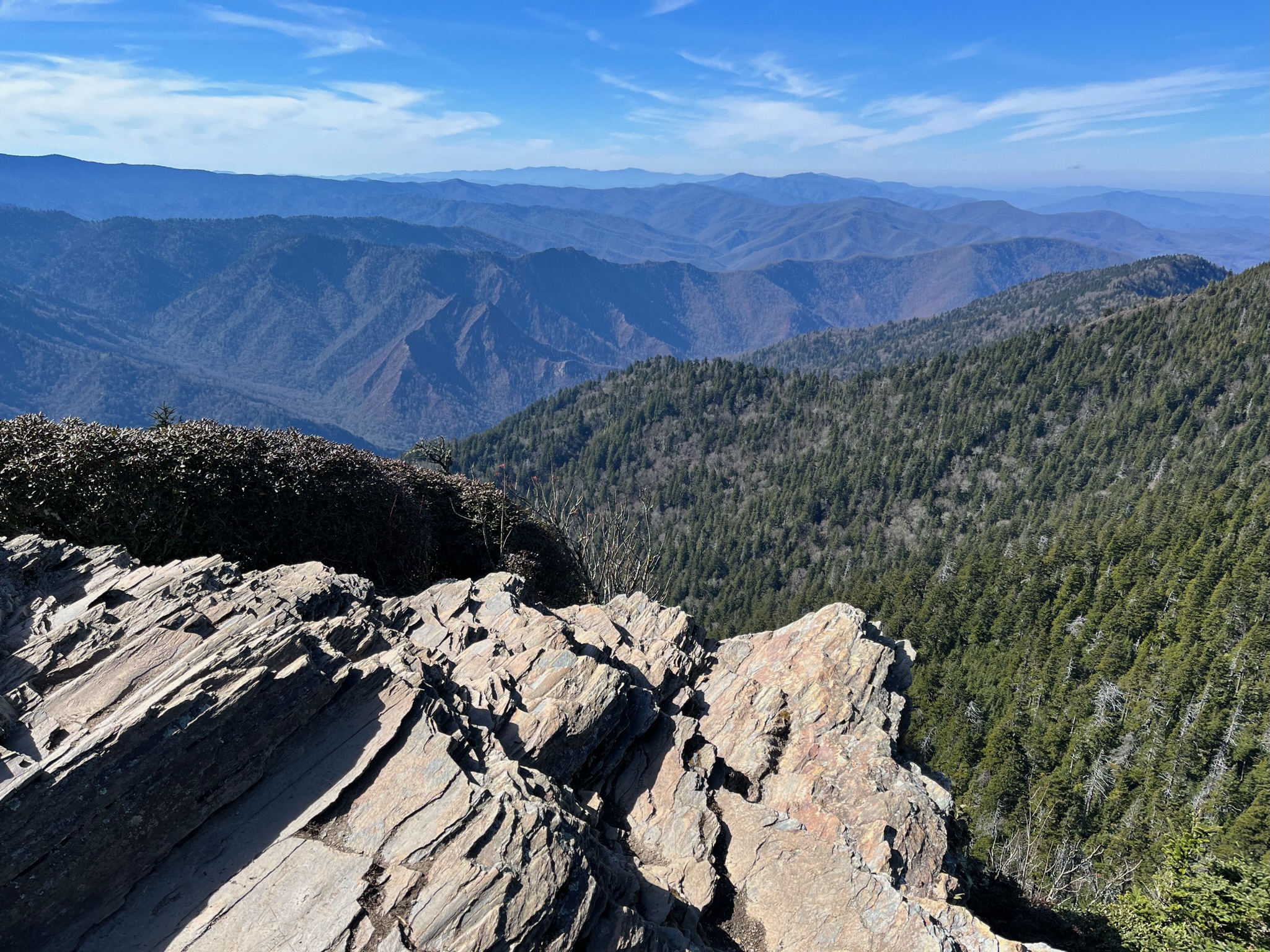
From there, it was about a third of a mile further up to the cliff tops. At this high elevation, Fraser firs grow really well – and the path up was surrounded by them, along with thick moss-covered rocks. The wonderful pine smell permeated the crisp mountain air – it was the most intoxicating scent! We were so lucky as the cliffs at the top were in full sun providing great views and a perfect spot to eat our lunch. There was even a sun-warmed rock perfectly formed like a chaise lounger right at the edge – I could have taken a nap there if I wasn’t worried about rolling out the wrong way! 😉


Of course, what goes up must go down. The 5.3-mile hike down was easier, but still challenging. Towards the end, we felt that we would never arrive at the parking lot. From there, we drove to Clingmans Dome – which is actually the highest point in the park. They built an observation tower there in the 1960s. To reach it, you had to walk up a very steep sidewalk for about a half mile. It was very cold and windy at the top – we had to put on a cap and gloves. But it is was worth it since you had a great 360-degree view of the entire park from up there. We were thinking about staying for sunset, but it was too cold and our bodies were ready to go back to camp and eat something warm.


The tall mountain behind us on the last picture is Mont Le Conte which we previously hiked. This was our biggest walking day on this trip. According to our phones, we walked over 14 miles, more than 35,000 steps, and climbed the equivalent of 168 floors! We went to bed pretty early that night.
The next day we crossed the park heading to Pigeon Forge, Tennessee. Along the way, we stopped at the Chimney Tops picnic area where we took a short hike and ate lunch. This area was in a cove that featured a majestic hardwood forest. The conditions there allowed trees to grow to their full potential. Oak trees for example, soared straight up into the sky, which was so different from the stunted twisted oaks we are used to in Minnesota. There was also a cool stream that flowed around and over giant river rocks. We spent some time hopping from rock to rock, and searching the clear mountain waters for fish.


At Pigeon Forge, we went to the quintessential Smoky Mountains experience: Dollywood. We had a fun time watching the shows and people. We rode an old steam train and a wooden roller coaster, and ate some good barbecue and cinnamon bread. We saw a replica of Dolly Parton’s childhood cabin, but were a little disappointed there were not more exhibits about her. Apparently they are working on this and it will be open in 2024. We all need a little more Dolly! 😉


Our final stop in the Great Smoky Mountains National Park was Cades Cove, which is in the western part of the park. It is a scenic mountain-surrounded valley that was settled in the early 19th century. Historic cabins, farms and churches still stand along an 11-mile loop you can drive or bike. It is also a popular area to see bears and deer. We drove the loop on our first day, stopping at several of the historic sites. The old homesteads were perfect examples of early Appalachian living. There was an old working grist mill at one of the homesteads that I found fascinating. Water was diverted from a stream a couple hundred yards above the mill and routed through a wooden flume to the top of the mill wheel. The next morning we biked the loop and saw a bear sleeping in a distant tree. It was a little hard to see, but I was happy we did spot one.


The Great Smoky Mountains were a pretty special place and a perfect ending to our Appalachian mountain tour which started all the way up in Quebec and Maine, and continued through New Hampshire, Vermont, New York, Pennsylvania, Virginia, North Carolina and Tennessee.

Leave a Reply