
We left Punakaiki and continued up the west coast to the bigger town of Westport. This drive has been called one of the most scenic in all New Zealand, and that is saying something! The mountains tumbled into the ocean, making the road a winding adventure along cliff sides and across steep river valleys emptying into the sea. There were also lots of big rock formations jutting out in points. And finally, the vegetation was incredibly lush – with both Nikau palms (the only New Zealand native palm) and fern trees vying for attention amongst the densely forested mountainsides.


We did some grocery shopping in Westport and filled with gas (there are very few gas stations in some areas so you do have to plan ahead). We then headed inland to cut across the northwest tip of the south island towards Abel Tasman National Park. There are no roads that go around the coastal tip, so this was our only route. We still had to cross some mountain ranges though, so it wasn’t an easy drive. The mountains were different here, more pine trees and deciduous trees – and less ferns and palms. It looked more like the mountains in the US or Europe. At one point we came across a helicopter in a steep valley scooping water out of the river and dumping it up on the hillside. We didn’t see any smoke, so hopefully it was just training. Eventually the mountains opened up into some flat valleys where we saw lots of cultivated lands with hops, kiwis, apples and some vineyards. I have never seen so many hops being grown in one place – it apparently is the perfect spot in New Zealand for them. The last part of the drive had us going over another mountain on a very small windy road to reach the small beach town of Marahau, which is on the southern border of the Abel Tasman National Park.


The next morning we took a “water taxi” to Anchorage beach – about eight miles into the park. The water taxi was a speedboat that accommodated about 20 people. What was funny, however, is that you got on it on land while it was on a trailer hooked up to a tractor. The tractor then drove down the road to the launch where it was backed into the water. The reason for this is the tide changes over 15 feet twice a day. At high tide, the launch is right at the edge of the town. At low tide, they have to drive the boats nearly half mile on the beach to reach the water.


The boat ride was fun. The driver took us by a few sites along the way. One was called Split Apple Rock, which was a large granite boulder that had cracked in half. We also went by an island that is home to a sea lion colony. When we arrived at Anchorage beach, we had to take our shoes and socks off as we had to walk in the water to get from the back of the boat to the shore.


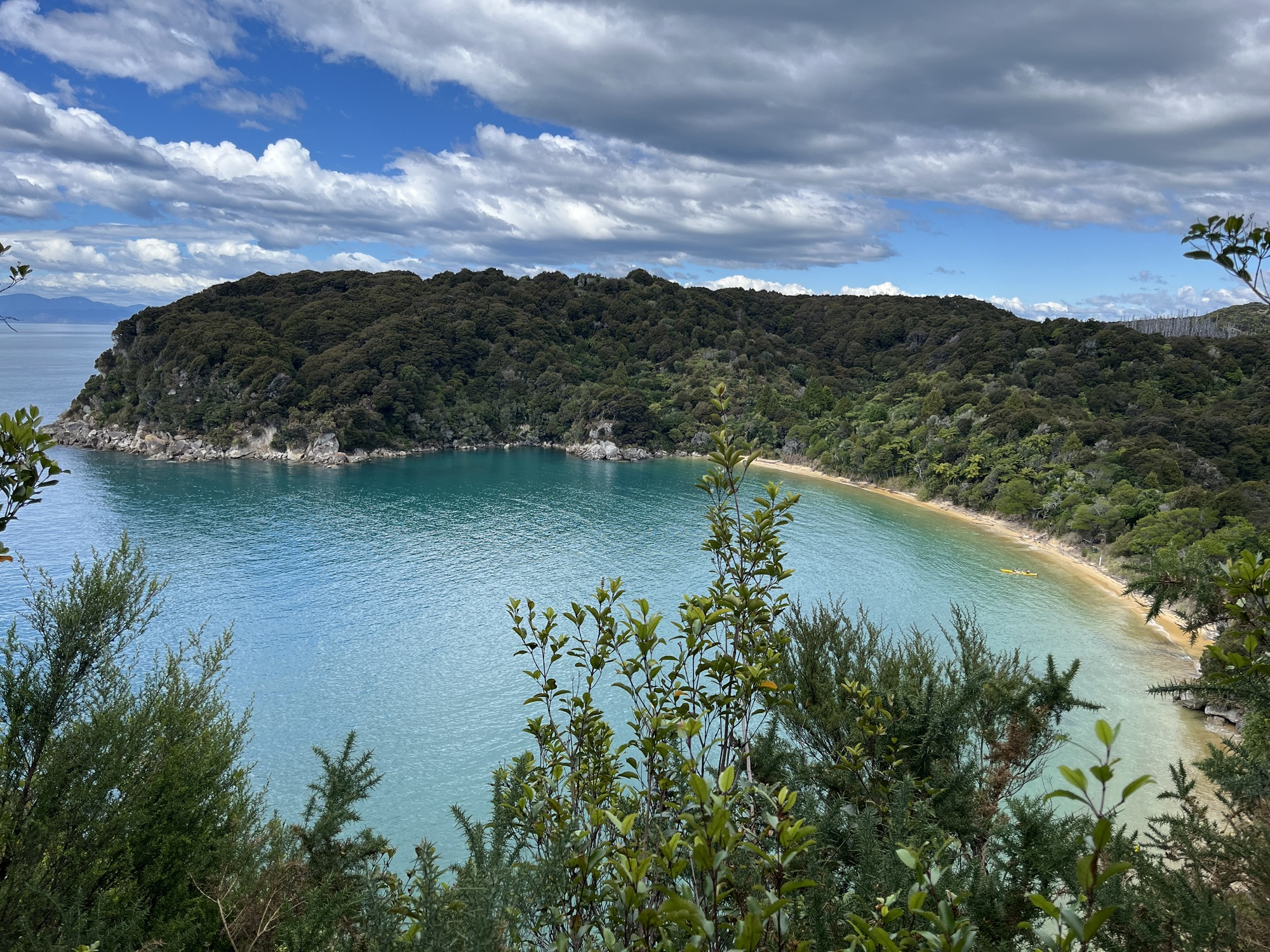
The water in the bays was an incredible turquoise color, and the sand was a golden yellow from the granite rocks that make up the area. Our plan was to hike back to our starting point following the Abel Tasman Great Walk trail. We also explored some of the side trails to different points, lookouts and beaches. The trail climbed up mountains, around coves and over points, providing some great views. The forest was nice with lots of fern trees, but it was not as lush as the rainforests on the west coast. It was much drier, but it made up for it with the coastal views.


We had packed our swimsuits and a towel in case we found a beach that inspired us to take a swim. Unfortunately, by afternoon the weather had gotten cloudy and cooler, and then it started raining during the last half hour of our hike. When we got back to town after walking 13 miles, we were ready for a beer. Luckily there was a little restaurant called Hooked next to our campground where we enjoyed coconut milk ceviche made from fresh locally-caught red snapper, and local Sprig + Fern beers.


Leave a Reply