
We hired a private guide and driver to take us on a two-day adventure in the countryside north of Siem Reap. We were interested in seeing some of the more remote temples that were now easier to access thanks to recently built roads.
Kulen Mountains
Our first stop was Kulen Mountains, the sacred birthplace of the Khmer empire. It was high atop these mountains that Prince Jayavarman II proclaimed himself a “god-king” in the year 802 and declared independence from the Java kingdom – marking the start of the Khmer empire. In Hinduism, the higher you are, the closer you are to the gods.
A plateau on the mountain became the first capital city, offering a strategic and symbolic foundation to defend the new empire. There was a deep spring there to provide water to the city, which the Khmer learned to harness to expand their kingdom, grow rice and support larger and larger populations. To reach the mountain top, we followed a dirt road for ten kilometers through the jungle. Our first stop was a beautiful cliff-top view.


The mountains contained several ancient monuments and temples dedicated to Shiva – including the valley of the thousand lingas – and other carvings located in the riverbed of the Kbal Spean. At first it was hard to see the carvings. Then suddenly we noticed one after another, and soon we realized the entire riverbed was covered in lingas and carvings from Hindu mythology. Each linga “spout” faced directly north. It was difficult to capture the scale and details of the carvings with our cameras as most were under the running water. Further up the river, we saw the natural spring, surrounded by shrines. The locals still come there to bathe in the water in a religious rite.


The Khmer population multiplied quickly and outgrew its mountaintop location. Other capital cities were started elsewhere as the empire expanded, and eventually more important sites and temples like Angkor Wat and Angkor Thom were built. The mountain remained an important symbolic area for centuries to come and rulers would build shrines there to reinforce their power and godliness.
A great example of this is the Phnom Kulen reclining Buddha reaching nirvana, carved directly in the rock at the highest point of the mountain. Located in the Preah Ang Tom Buddhist temple, it was built in the 16th century. It is the biggest reclining Buddha in Cambodia, measuring 8 meters (26 feet). An accompanying shrine was erected below and this place is still a popular pilgrimage spot for locals. For centuries, the Buddha was inaccessible from the ground and you could just view it from below like it was floating in the air. A roof was later constructed to protect it from the elements and stairs were built so you could walk up to it. I think that kind of ruined the illusion.


Beng Mealea Temple
Driving down on the far side of the mountain, we headed to the jungle-covered temple of Beng Mealea. Until recently, the only way to reach this temple was on bumpy jungle roads by motorcycle. Today there are paved (but still bumpy) roads that are much more tolerable. We stopped to buy our entrance tickets in a little village across from a school that was just being let out. Several girls lined up across the road and put their hands in a prayer gesture to stop traffic before a crowd of uniformed students spilled out of the school gates – some walking and some on bicycles. It was very cute to see.


Beng Mealea was built in the 12th century at about the same time as Angkor Wat based on its architecture. As usual, we had to cross a moat and walk on a long causeway to get to the temple. As we were approaching, our guide said they had recently cleared out over 1000 unexploded ordinance within the temple grounds, a sober reminder of the recent wars.
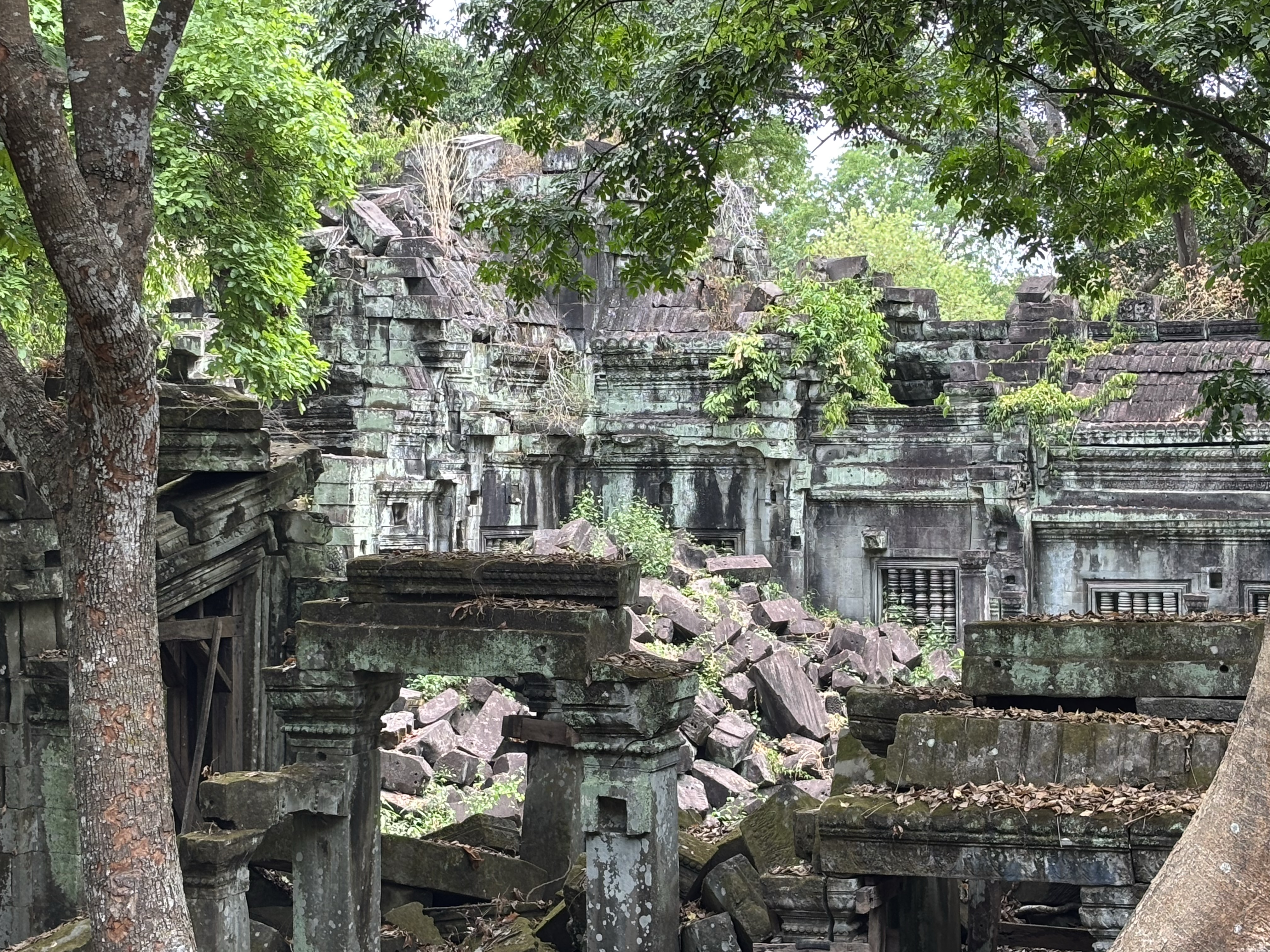
Unlike many of the temples in Angkor, this one has seen limited restoration work. Giant piles of fallen rocks from the ceilings and upper levels are mostly sitting where nature left them. Strangler figs are bracing some areas to prevent collapse, while the roots are deteriorating other areas. Our guide told us that at one point the temple was covered in gold, silver and precious jewels – long-ago looted or repurposed. It definitely had an Indiana Jones vibe and we loved it!


As we drove to our next destination, we admired the Cambodian countryside. It was much flatter and fertile than we had imagined. There were mango and cashew tree orchards everywhere, along with a wide variety of other fruits, vegetables and crops like tapioca and rice. We tried snapping some pictures while driving, but it was hard to get a good shot.


75% of the Cambodian population is still rural and relies on agriculture. While rice is the most widely grown crop, they are slowly developing other crops for export. For instance, Cambodia is now the second largest exporter of cashews in the world and expects to be the largest by 2030.
When we were there, the locals seemed to be most occupied with the tapioca harvest. Tapioca is made from the roots of the cassava plants. It is also called manioc or yuca in some other areas of the world. It is a perennial shrub adapted to the hot conditions of tropical lowlands. Cassava copes better with poor soils than many other food plants. Cassava plants are propagated from the shoots of old plants, and we saw lots of bunches of the plants stuck in dirt to start the sprouting process again. It can be harvested every two months, although it takes ten months to grow to full maturity.


We observed farmers chipping up the roots in their yards and spreading them out on large tarps to dry in the sun. The main thing made from tapioca is flour, which is used to make breads and cakes as they don’t grow wheat. Turns out, a lot of the bread and baguettes we have eaten in South East Asia were probably made with tapioca flour. It is gluten-free and slightly sweeter than wheat grains, but it doesn’t have any protein and it is low in vitamins and minerals.


Our guide grew up on a rice farm and he told us that when he was young, they still used a water buffalo to pull the plow and all the rice seedlings were planted by hand. It was only in the last 15 to 20 years that small “tractors” from Thailand have replaced the water buffaloes and cows. We saw many, many of these small tractors on the road pulling trailers. These primitive tractors kind of remind me of a large rototiller. There is a small engine set between two tires and two long handles that allow the driver to steer it by sitting on the front of the trailer or implement. Many appeared to be belt driven, and besides transporting bags of rice, loads of tapioca, and other farm goods – it wasn’t unusual to see an entire family sitting on the trailer getting a ride to the town or market. It was a slow, bumpy affair – but it probably beats riding a water buffalo.


Koh Ker
Our next destination was the interesting temple of Koh Ker – another site that is only recently accessible by more modern roads. It was recognized as a UNESCO site in 2023. This site served as the Khmer capital for a brief time between 928 and 944. Historians are not really sure why the capital was moved there, or why it was moved back to Angkor so soon after. Over 180 structures were built, including temples, reservoirs and roads.
The architectural style featured large monolithic stone blocks and grand-scale buildings. The most striking is the 35-meter (115 feet) tall, seven-tiered step pyramid of Prasat Prang. It was dedicated to Shiva and at one time had a 10-meter tall Linga projecting from its very top. We couldn’t help comparing it to the Mayan temple of Chichén Itzá. It was roughly the same size, similar shape and built around the same time period. Pretty amazing that these ancient civilizations in different parts of the world might come up with such similar designs!
The stairs to the top were extremely steep, but luckily they had made a new set of stairs on the back side that gave us the ability to climb to the top more easily (although it was still 167 steps in 95-degree heat). The views of the jungle at the top were impressive, as was the fact that we could scramble up and down huge blocks to explore the top level where the tall linga was once mounted atop carved lions holding it up.


As mentioned before there were many temples throughout the site of Koh Ker. Another one that we found really interesting was Prasat Pram, meaning “five temples”. It featured three prominent brick towers on a single platform all facing east. In front of these were two smaller structures that were libraries, built to store religious texts. They were made more interesting by the massive strangler fig trees that have grown around the towers – almost like they are trying to keep them together.
Some recent restoration work has been happening to these temples. One project was removing about three feet of sediment, exposing the beautifully preserved foundation and platform. Some workers were painstakingly trying to shore up the middle tower by carefully removing, cleaning and reaffixing the bricks, one at a time. There was a nearby pile of unearthed bricks waiting to be used- including a small stack that had connected carvings. What a jig-saw puzzle!


From Koh Ker, we drove a couple hours more to our Cambodian hotel outside the village of Sra Em. We spent the night there for just $15, cash only. Luckily we had a guide as they didn’t speak any English. We ate our supper at their restaurant, where really large wooden tables and massive chairs furnished the place. It was a bit odd and eerie though, as we were the only ones there. We shared some traditional Cambodian dishes with our guide and our driver, and we learned more about their families and lives. Once again, we heard about the devastating effects of Covid on their economy and schools. Without tourism, nearly everything shut down. No work, no money, no school, little food for three years, and it has been almost 5 years now without their pre-Covid income level. They are not out of the woods yet as tourism from non-western countries has not returned. China used to be one of the largest sources of tourism, but China’s economy has not recovered yet so they are not traveling like they used to.


Preah Vihear
The next morning, after eating a surprisingly good duck egg omette with baguette (tapioca-based) at the restaurant at our hotel, we set off for one of the most reveared temples in the Khmer empire: Preah Vihear, built in the early 9th century and expanded several times through the 12th century as each new king wanted to make his mark on the temple to impress the gods.
It is perched on the edge of a 525-meter tall cliff in the Dangrek Mountains range right on the border with Thailand. To access it, we needed to hire a 4WD pickup truck. We sat in the back as it drove in low gear up a really steep mountain road. Lucky for us, the original rocky road had recently been replaced with a smooth cement road.
When we arrived at the top, we noticed several bunkers and military men. Across the valley we could see Thai buildings and the Thai flag. Thailand disputes Cambodia’s ownership of the temple and the location of the border. This dispute goes back to the drawing of the borders during the French colonial era. The dispute came to active fighting though, between 2008 and 2011 after the temple became a UNESCO World Heritage site. Thailand attempted then to seize control of Preah Vihear. Dozens were injured and killed, and damage was done to the temple.
Today both countries maintain an active, armed force on both sides. We didn’t see any machine guns, but we were told they were ready in the sandbag bunkers spread throughout the site. We saw a soldier in one bunker scanning the Thai side with binoculars. We hadn’t realized how “real” the rivalry between the two countries was till we got there.


Our visit started at the bottom end of the sloping cliff top, where large stairs with Naga sculptures flanking them invited you to go up to the first of five pavilions. The pavilions lined an 800-meter causeway that climbed to the cliff top. The stairs and first pavilion were in poor condition and in the process of being restored through a grant from the U.S. Ambassador’s fund. They were likely damaged during the Thai conflict as that part is the closest to the Thai position.


Upon arriving at each pavilion, the views got better and better. In between the pavilions were large courtyards. You had to use your imagination to appreciate the scale and grandeur of this layout. The wide path going up was laid with big quarried stones. Based on large-diameter holes carved at the base of the pavilions, massive tree-trunk columns once held up a series of timber roofs – likely covered in tile. There were also many carvings and bas-relief throughout.


The final pavilion was at the top and it was the largest. We admired the tall, thick walls and doorways. I was struck by how similar the large stone block walls were to the ones found in the Inca temples in Peru. Each stone was carved to fit perfectly with the next ones without any mortar.
This pavilion featured the inner temple of Prasat Preah Vihear, the most sacred place in the most sacred temple. We could not enter it however, because a Buddhist monk was praying there. We could see him from the window. Our guide said sometimes monks would come to that spot to meditate for an extended time as they worked to reach enlightenment.


It was hard to take pictures of the complex as it was so spread out, and there was no area where you could see the whole thing. Unlike most of the other temples we visited, it was deserted and we only saw a couple of other tourists walking with guides during our time there. Our guide had not been back to Preah Vihear since 2019 and he mentioned that the post-Covid tourists haven’t ventured much outside of Siem Reap. I really wonder how the locals are making a living now as it once was a popular tourist spot.
Banteay Srei
After riding back down the mountain in the back of the pickup truck, we hit the road again back towards Siem Reap. We were taking a different route that would bring us to Banteay Srei, a beautiful temple built in 967 by Yajnavaraha, an important guru (spiritual teacher and counselor) to the king in power then. Yajnavaraha was known as a learned scholar and compassionate philanthropist who dedicated himself to helping those suffering from illness, injustice or poverty. Because he wasn’t a king, his temple was smaller and more compact.
However, he made up for that in the elaborate carvings and decorations found throughout Banteay Srei. He clearly had refined taste and a commitment to artistic excellence. We found it to be one of the most beautiful temples we saw, with all its amazingly intricate carvings in red sandstone. Our guide pointed out one in particular, featuring a lovely lady, and he proudly said that she was the Mona Lisa of Cambodia!


We really enjoyed our two-day tour and would highly recommend our wonderful guide Dara (and our skilled driver Chad). If you ever decide to go to Siem Reap, let me know, and I will send you his contact info. You can also find him on ToursbyLocals.com, which is where I discovered him. Cambodia is such a worthwhile country to visit, one of the most unique places in the world with such welcoming and genuine people! Cambodians we met during our two stays said over and over how much they appreciated us visiting their country and their temples. So, come to Cambodia – you won’t regret it and they could really use our tourism dollars.
[Which reminds me of one travel tip: Cambodia is unique in South East Asia in the fact that you can use US Dollars everywhere, and also withdraw USD from the ATMs. Due to inflation, they might even prefer USD to their own currency. However, you need to keep your bills in good, crisp condition – no rips or tears or tattered edges as the local banks won’t accept them. Therefore the local people are very careful when accepting them, several of our bills were refused because of that.]
On our way back to Siem Reap, I mentioned to our guide that I liked his sunglasses. He said he recently bought them for $12 in a shop near our hotel. So, we stopped there on our way back and I got matching sunglasses, which he thought was really fun!
We flew out of Siem Reap from their brand new airport built by China. It is now located an hour outside of town, so no tuk tuk ride there anymore… It is a massive building, but not busy at all yet. It only took us 10 minutes to check in, go through passport control and security, before reaching our gate. Our next destination is the city of Luang Prabang in Laos 🇱🇦!


Leave a Reply