
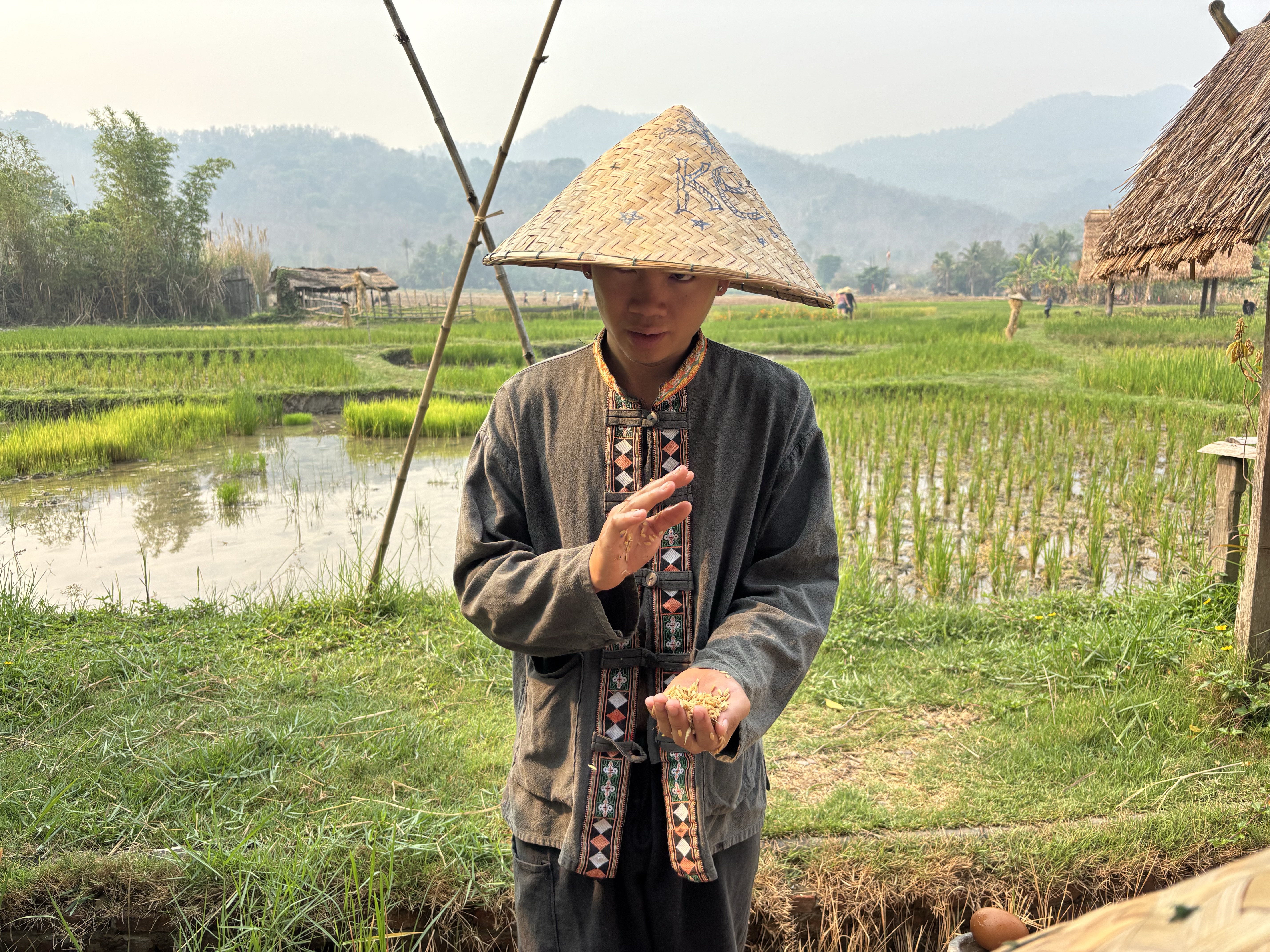
I got back to my farming roots with an excursion to a rice farm on our second day in Luang Prabang, when Sophie and I visited the Living Land Community Farm (livinglandlao.org). It was a fantastic experience and one of our favorite activities during this trip!
After being picked up at our hotel by a tuk-tuk, we arrived at the Living Land Community Farm where we spent the morning with fellow travelers from Canada and France. A very friendly young man named Keo, a member of the Living Farm community, was our tour guide. His English was excellent (the Living Farm teaches free English classes at night to the local children) and he made the tour very fun!
We learned about the 14 steps of growing rice in a very hands-on way, and in an idyllic environment surrounded by mountains in the middle of ancient rice terrasses. We have much more admiration for rice now that we understand the process of growing it a little better!


Our farming experience started with a little orientation in a traditional Lao farm house, then on to selecting rice grains for seeding. Soon we were standing in muck up to our knees seeding our rice grains in a prepared paddy, then selecting seedlings for replanting in another terrasse. The mud was squishy and soft, but it was quite a challenge to walk in the paddies without tipping over. We saw how the fields had to be prepared for planting and I even got to do a little plowing behind Susan, the water buffalo.


After plowing, it was time to plant our seedlings pushing them into the mud with our hands. We kept on moving to different paddies to witness the growing process till it was time to harvest the ripe rice. When we were done with that part, we got to wash the mud of our bodies and moved on to learn about other steps before the rice is ready for consumption. Threshing the rice, separating the grains from the other debris with a hand fan, husking them using an ancient tool resembling a big pestle and mortar, grinding them, etc…
This was actually a really fun and interesting experience for us. We learned a ton about the traditional ways of growing rice – amazing how much work it was. We also got to crush sugar canes on an ancient wooden press to make delicious juice, a very refreshing beverage in this hot climate.


Everything on the farm was made from local supplies – particularly from bamboo growing around the land. It was astonishing to see how many useful things they made with it! For instance: baskets, fish and mouse traps, hats, houses, walls, cooking implements and more, all beautiful works of art!
Three retired farmers gave us demonstrations on how they made some of them – starting with splitting bamboo poles to create paper-thin strips for weaving. It was pretty incredible to watch, and made you feel a little sad how far we have come with unnatural plastic replacements for most of these things.
The bamboo hats we got to wear while there were great, and we would have gladly brought them back home with us if we would have been on the last end of our trip. At the end of the tour, we got to sample various rice snacks prepared in different ways, yummy! We highly recommend this rice experience to anyone traveling to Laos!


In the afternoon, we headed to the Kuang Si Waterfalls about an hour south of town. We had never seen falls quite like these: they cascaded down the limestone mountainside branching into many small falls and dozens of pretty azure pools at the base. Despite being in the dry season, the flow of water was still impressive. And to top it off, you were welcome to swim in these pools, which was a great way to cool off in the 90-degree-plus heat. After climbing all the way to the top of the falls on one side, we went down the other and found a secluded swimming spot near one of the falls. It was very refreshing after the climb! The only thing we didn’t like was that the little fish wanted to nibble on our feet when we stopped moving…


We ate supper that night at Khaiphaen, a restaurant that educates and employs marginalized youth – teaching them how to work in a restaurant and learning English while doing it. This was one of the best meals we had on our trip. We tried Lao pork sausage and a delicious fish soup, with beer and sticky rice, and finished our meal with banana fritters. Our bill came to 244,000.00 Lao Kip which converted to $11. They also provided a conversion to Thai Baht on the bill which didn’t come out as good (see photo).
We have been pleasantly surprised by how much we like the Lao cuisine. We found it less spicy than Thai food, less overpowering than Malaysian and a little bit different than Vietnamese food. They seem to use more vegetables (which we like), with a nice combination of fermented fish sauce, kefir lime leaves and herbs and roots. They also eat sticky rice with every meal, which we learned how to make the right way at our farming adventure (the key is to soak the rice overnight before steaming it). The sticky rice is served in cute individual bamboo baskets – another item we would have loved to bring back home.


On the way back to our hotel, we stopped at the night market to purchase a few souvenirs from some very talented vendors, including a beautiful print from a young artist. The local Hmong tribes are very skilled and the quality of all the handicrafts was quite impressive. We enjoyed walking through lovely Luang Prabang at night one last time. We would leave the following day by train to reach our next destination, the city of Vang Vieng.


Leave a Reply