
Vientiane is the capital city of Laos. We arrived there from Vang Vieng by train and were picked up by a private car from our hotel as the train station is not close to the town center. Like the country, the capital is “developing.” That means lots of construction and lots of variety in terms of nice and not-so-nice buildings and streets. The street in front of our hotel was completely ripped up as they were installing new utilities. That somehow didn’t stop cars, scooters and pedestrians, however, from using the street. One had to be very careful to not fall into a trench.
To be fair, Vientiane has had a difficult history enduring countless attacks over the centuries mainly by the Siamese (Thai) and Burmese Armies, with the worse being the complete annihilation of the city by the Siamese army in 1827. Everything – including temples and historical monuments – was destroyed, and the city was abandoned for decades. Under French colonial rule, the city started to be rebuilt in the late 19th and early 20th centuries. But, WWII, Laos war for independence from France, the Vietnam War and America’s “shadow war” in Laos stunted much of its development. Despite these setbacks, you can see the city is working hard to improve as best it can with limited funds.


As a former French colony, Laos has its own version of the French baguette sandwich that some say pre-dates the Vietnamese Bahn Mi version. The Lao version has some pâté spread on the bread, then some pork meat and lots of pickles and veggies. We tried this for dinner on our first evening in Vientiane as we ventured out on the crazy streets around the hotel. We watched two ladies prepare them in front of us and ate them on the spot. It was quite good and very inexpensive.


We had chosen our hotel – the Salana Boutique Hotel – because of its location, close to the river bank where there was a large night market. After seeing so many amazing handcrafted items in Luang Prabang, we were very surprised (and a little disappointed) that this night market was nothing like the one in Luang Prabang. It catered more to the domestic tourists and the locals. There were hundreds of stalls of cheap clothes, housewares, etc, as well as some food vendors and a little carnival area for younger kids. It was a popular place, but not for us.
The weather was pretty hot, so we decided to head back to our hotel to have a quiet air-conditioned evening and enjoy the nice bar area overlooking the city. The hotel featured lots of pretty and impressive carved wood objects throughout the building. We also appreciated the little elephant which welcomed us to our room. The elephant is a powerful symbol in Laos, representing strength, prosperity, and good fortune.


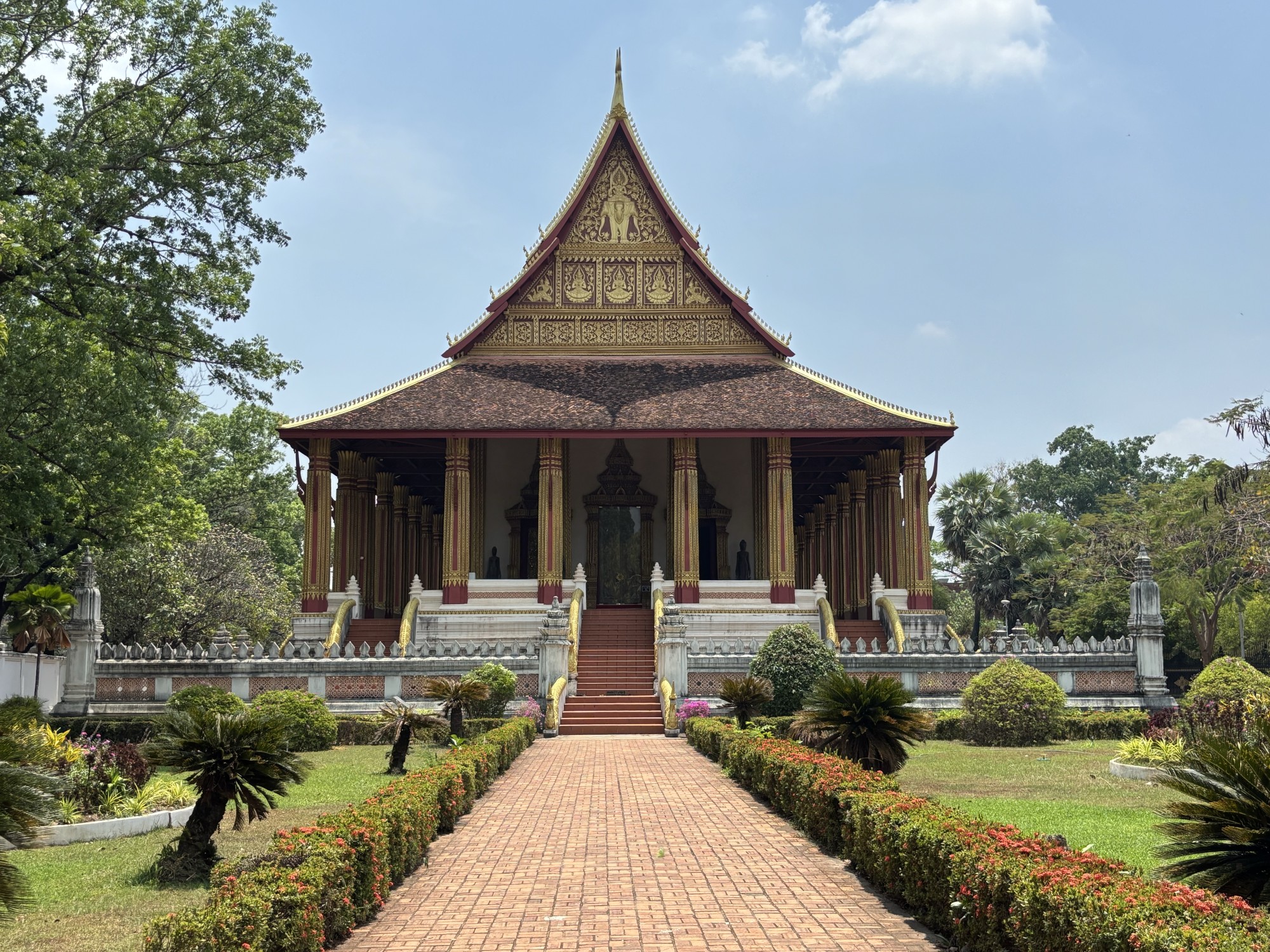
On our second day, we walked to several of the main tourist sites in town. We walked by the Presidential Palace (where the president lives and works) on our way to Ho Pha Keo temple constructed in 1565. This temple was once home to a revered emerald Buddha, which was stolen by Thailand in 1779 and is now located at Wat Phra Kaew (the Temple of the Emerald Buddha) within the grounds of the Grand Palace in Bangkok, Thailand. We were fortunate to see it in 2023 when we visited Bangkok. Ho Pha Keo is now a museum of Lao religious art which gave us an appreciation for the city’s deep spiritual heritage.


Next we visited Wat Si Saket which was just across the street. It is the oldest temple in Vientiane that has survived in its original form. It was very unusual in that the main temple was surrounded on all sides by a covered cloister whose interior walls housed thousands and thousands of tiny Buddha statues. We found the temple and surroundings quite striking and tranquil despite being in the center of the city.


Next we walked down the broad main boulevard street to the Patuxay monument. Patuxay means Victory Gate and it is Laos’ “Arc de Triomphe”, celebrating its independence from France and commemorating those who died fighting for it.
A poster highlighted its differences from the French version: the Lao Patuxay has four front gates with passages through one another and a top, with the upper structure resembling the Taj Mahal palace in India. It was built between 1957 and 1968 using cement the USA had provided for building an airport. They seemed quite proud of the fact that they repurposed the cement for this monument.
We paid an entry fee to climb to the top. There were some exhibit rooms on the way up that had some interesting information about Laos and its different ethnicities (Akha, Brao/Lavae, Hmong, Katu, Lanten, Yao Mien and Tai Lao). The views from the top were good, but Vientiane is certainly no Paris.


After visiting the Patuxay monument, we went to Talat Sao, a nearby shopping mall, in an attempt to cool off in moderately cooler A/C while we unsuccessfully looked for a food court that a guide book raved about – it had apparently closed since the guide was published. There were dozens and dozens of woven silk garment vendors there, selling beautiful traditional Laotian dress clothes. As it was sweltering hot by then, we took a colorful tuk-tuk to our next destination and enjoyed the ride discovering a different part of town.


Our final stop for the day was a sobering one. We visited the COPE center. COPE stands for Cooperative Orthotic and Prosthetic Enterprise. It is a non-profit organization that provides support to people with mobility-related disabilities in Laos, caused by the staggering amount of unexploded bombs left over from the Vietnam War era and the US secret war.
Laos is the most bombed country on earth. Between 1964 and 1973, the US flew 580,000 bombing missions in Laos. Over 2 million TONS of bombs were dropped all across the country side. The intensity and scale of this bombing was equal to one planeload of bombs every eight minutes, 24 hours a day, for nine years. It was all because the US was trying to stop the march of communism and prevent Laos from providing supplies to Vietnam.
Most of the bombs were cluster bombs, that littered softball-sized bombs everywhere. They estimate that 80 million of these small metal balls were dropped. And because 10% to 30% of them typically failed to explode upon impact, it is estimated that anywhere from 8 to 24 million of them are left – just waiting for a kid to play with them, a woman to cook near them or a farmer to hit them with a tool.
These bombs have killed and maimed thousands of innocent people over the decades. Tourists are warned to stay on main roads and known paths as the danger of finding unexploded ordinance is still very real. The US was one of the biggest funders of mine sweeping efforts up until the Trump administration stopped all USAid funding for de-mining operations earlier this year. It is unfortunate as there are many areas left to clear and Laos relies heavily on foreign aid to be able to continue the process.


After our visit of the Cope Center, we decided to head back to the Night Market by the river for supper. Some locals were exercising near the river banks and it felt a little less hot there. All the restaurants looked similar, so we just chose one less busy and enjoyed some Beer Lao with fried cashews and a stir fried dish.
On our way back to the hotel, we walked through the grounds of the Wat Ong Teu temple and Buddhist monastery. We admired the architecture of the buildings, many more Buddha statues and an impressive Bodhi tree, which was brought from Sri Lanka and planted there by a famous Buddhist monk called Narada Mahathera who travelled to many countries to conduct missionary work.


On our last day in Laos, after a laundry run, we booked a private cooking class with the enterprising and enigmatic Madame Phasouk. She took us to a local market, then we went to her house where she taught us how to prepare Orh (Lao traditional beef stew), Lab Khai (a chicken spicy salad with banana flowers) and Tam Mak Hung (green papaya salad). She also prepared an extra soup for us, and we got to eat all of these for an early dinner that day, with a side of sticky rice served in a little bamboo container of course!
Madame Phasouk talked to us the whole time about her life experience in Laos. It was interesting, but not always easy to follow. We understood that her father may have been a capitalist, something a bit precarious after the communists took control. Her mother was a director of a notable school with connections, which somehow shielded her and her family from communist consequences.
Madame Phasouk told us that she was very intelligent in school, and got a scholarship to get her PhD in economics at a university in Russia – where she also learned Russian. She held some pretty high posts in a bank at some point, owned and operated several small businesses and raised a successful family. She said we were very lucky to live in a “big” country, seemingly admired Trump and told us she buys gold whenever she saves enough money to avoid the pitfalls of the falling Laotian currency. We certainly learned a lot from this cooking class!


We feel very fortunate and happy to have been able to discover a small part of Laos. It has not only given us a better understanding of this part of the world, but also a better appreciation for the history and culture of the many Laotian/Hmong people who make the Twin Cities their home.
Now, onto our next destination taking an overnight flight to Seoul, South Korea 🇰🇷
Leave a Reply