
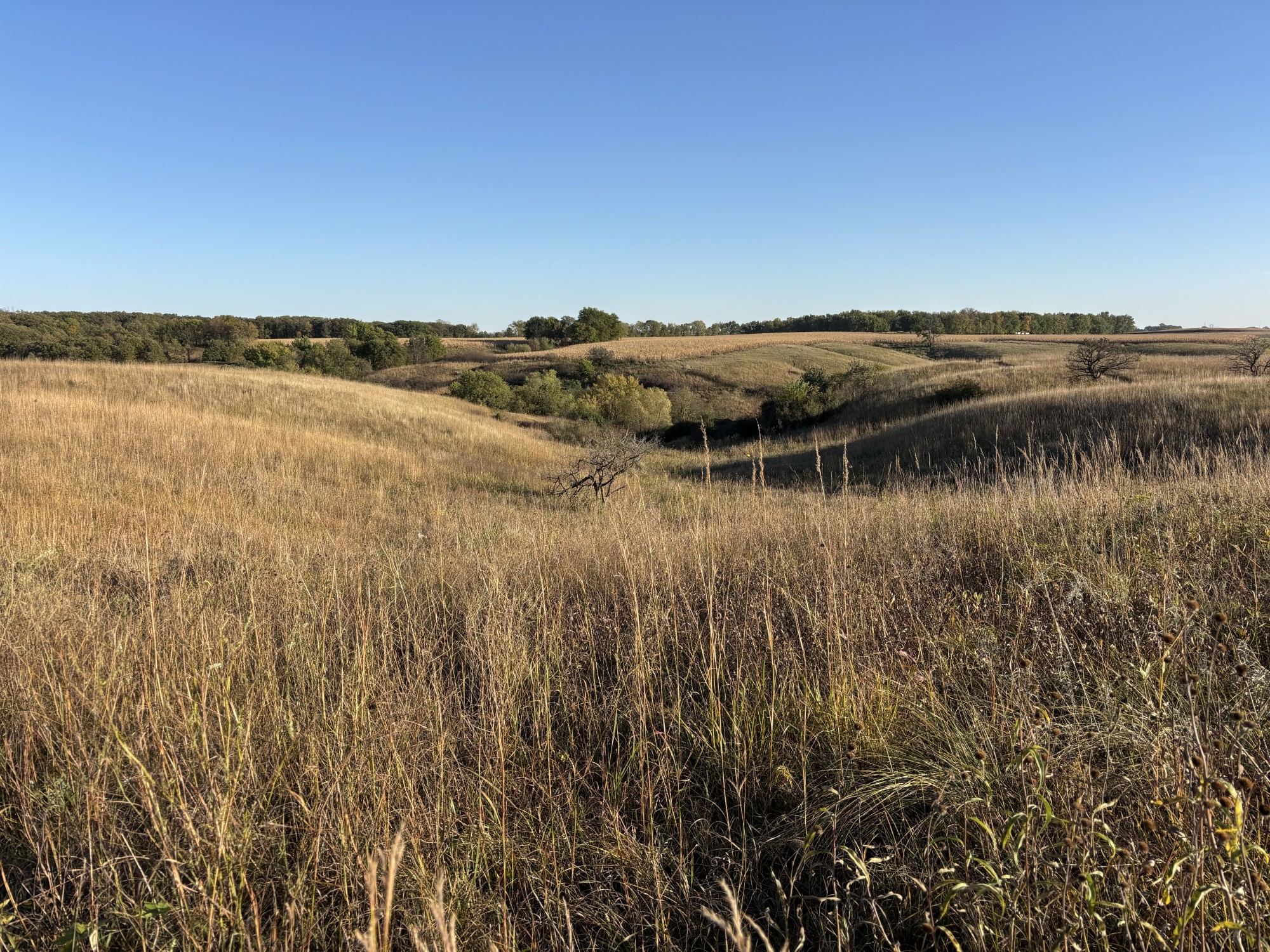
To take advantage of the beautiful fall weather, we decided to go camping in Southwest Minnesota this October – an area we had not yet explored.
Our first brief stop was Fort Ridgely State Park where we saw the ruins of a fort that played a pivotal role in the U.S.-Dakota War of 1862. We then drove through Sleepy Eye and Walnut Grove of Little House on the Prairie fame.
We stopped in Walnut Grove, but the museum was closed unfortunately. Sophie remembered reading all the Little House on the Prairie books while growing up in France. To her, they were very exotic – talking about blizzards and big open spaces – she never thought back then she would actually end up living in Minnesota!


Lake Shetek
We camped at Lake Shetek State Park the first two nights. It is one of the largest and most popular lakes in Southwest Minnesota – but it was pretty quiet at this time of year.
Sophie and I are working on a goal of hiking all the Hiking Club trails at each of Minnesota’s state parks. This trail took us across a causeway to a little island we walked around. In the afternoon, we biked a portion of the Casey Jones State Bike Trail to the nearby town of Currie, which had an interesting railroad park that featured some old trains and even a working turntable. We biked alongside lots of cornfields ready for harvest on mostly flat roads, and we enjoyed this little glimpse of Minnesota farmlands.


Pipestone
The next day, we drove to Pipestone to visit the Pipestone National Monument. Although the visitor center was closed due to the government shutdown, the grounds were open and we walked the scenic loop trail.
Pipestone (the actual stone) is a compact, fine-grained red-colored stone that is soft, smooth, and easy to carve – making it a preferred material for artisans. It occurs in thin layers often nestled between hard layers of other stone (like the Sioux quartzite found in Pipestone), which adds to the region’s geological diversity. The layer of pipestone happens to be close to the surface in this area, making quarrying it more accessible, though it still presents its own set of challenges due to the surrounding tough rock formations.
For over 3000 years, Native Americans have been quarrying pipestone to craft their ceremonial peace pipes, which hold significant cultural and spiritual value. This important tradition continues today, with Native people still quarrying in the area to honor their ancestors and keep the art alive.
We found the striking red pipestone beautiful, radiating warmth and vibrancy. We were equally captivated by the Sioux quartzite, which created stunning natural formations in various places, with their unique textures and colors that further enhanced the landscape’s allure. There was also a really cool, tranquil waterfall in one spot, and it gave me the chills just thinking about how people over the millennia may have been in the same spot enjoying this unique place.


Following our visit of the Pipestone National Monument, we stopped at a nearby gift shop built like a fort where we admired beautiful peace pipes and other objects made out of pipestone. After a picnic lunch at the city park across the street and a quick stroll through the town of Pipestone, our next stop was Split Rock Creek State Park for some hiking. We enjoyed another Hiking Club trail that featured a stunning vista of prairie grass in the late afternoon sun.


Blue Mounds
We camped that night in Blue Mounds State Park. This is an interesting place where hard Sioux quartzite rock rises up from the surrounding plain creating a large hill and interesting cliff faces. The quartzite actually didn’t rise up, but it was the surrounding prairie that eroded over the millennia leaving these rocks and hill protruding behind. The park is quite large and features a prairie that is now home to a buffalo herd. On our first evening there, we drove to the southern edge of the park were we saw the buffaloes in the distance as the sun set.


The next day we walked the 6+ mile Hiking Club trail. It started along a river that cut through the prairie, then continued along the upper ridge of the Sioux quartzite cliffs and returned along the prairie where the buffaloes roamed. It was a beautiful hike with amazing views.
We discovered Blue Mounds is home to the only native cactus in Minnesota: the prickly pear cactus. It grew quite prolifically along the top of the rocky ridge. You had to be very careful not to step on one as their long, sharp spikes could go right through the sole of your shoes. They were beautiful and exotic to us. Many of the cliff faces were tall and impressive – popular with rock climbers. We could see the plains below, with farms dotting the land. What a fun hike! We were lucky that it was a sunny, albeit windy, day.


The next day we rode a newly-paved bike trail into the nearby town of Luverne, MN. This trail went below the quartzite ridge, so we got a different view of the cliffs. It was another beautiful day and we enjoyed biking again.


Luverne is a very charming town! We stopped at the Rock County History Center first, where we learned about the Luverne Automobile Company. This company produced beautiful cars between 1903 and 1917, when it changed its focus to trucks and eventually became well-known for building fire engines.
We saw an ad for the 1911 Montana Special car, which boasted 50 hp and was touted as being built for the mountains. It was priced at $3,000, which would be nearly $750,000 today—so definitely not priced for the average Joe. We admired this amazing car, what a beauty!


The other interesting thing in the museum is a display of nearly 6500 nutcrackers (and counting). This started as the personal collection of Betty Mann, a charming 94-year-old lady.
Betty bought her first nutcracker on clearance at a Cracker Barrel in 2001 to cheer herself up, after she lost her husband and daughter right before the holidays. She said things kind of mushroomed after that and people started sending her nutcrackers from all around the world. She was manning the gift shop when we were there and was the sweetest lady. There were also quite a few artsy nutcrackers adorning the streets of Luverne.


We rode around town admiring the old homes and buildings before heading back to our camper in Blue Mounds State Park.


We ate a quick lunch and left Blue Mounds State Park. We stopped at Kilen Woods State Park on our way to New Ulm to tick off another Hiking Club Trail. Once again, the trail didn’t disappoint, and featured a variety of environments for us to walk through. We particularly liked the rolling hills covered in prairie grass.


New Ulm
Our final stop (and the impetus for this trip) was the city of New Ulm for a celebration of Oktoberfest. We camped in nearby Flandrau State Park and headed to Schell’s Brewery the next morning.
Schell’s is the second-oldest family-owned brewery in the country, started in 1860 by a German immigrant named August Schell. (The oldest is Yuengling’s in PA which we visited in 2023). The brewery is located in a steep valley next to the Cottonwood River, which provided access to clean spring water and ice for the natural refrigeration in caves dug under the brewery.
Schell’s Oktoberfest is extremely popular! Even though we showed up before they opened, the line to enter was a mile long. But everyone was in good spirits, and many in lederhosen holding their own steins! Once inside, there was fun German music, lots of food and of course, lots of beer. The grounds around the brewery and around August Schell’s house are very beautiful. Despite the long lines, we enjoyed the experience and we got to sample sausages, sauerkraut, beer and pretzels. After trying a little bit of everything and observing the fun events (like who can hold up their full stein the longest), we left to explore the town of New ULM.


New Ulm is very proud of its German Heritage – and has been since its founding. The downtown is very quaint and featured a working Glockenspiel built in the late 1970s. We got there just in time for the 3pm show.


But the most unusual thing in New Ulm might be the Hermann Monument – a massive statue sitting on a hill high above town. It was erected in 1897 by the National Sons of Hermann Lodges in the U.S. after a similar (but twice as large) statue was built in Germany. Hermann was a legendary leader of the German tribes who defeated the Romans in 9A.D. He became a symbol of liberty and unity in Germany. We bought tickets at the monument base and climbed to the top of the cupola for great views of New Ulm and the surrounding area.


Our final activity in New Ulm was walking the Hiking Club trail back at Flandrau State Park. It was another interesting trail that went along the Cottonwood river, through some woods and across a pretty meadow. The winds were picking up and the temps dropping by the time we got back. We enjoyed the warmth of our camper overnight, and a nice breakfast the following morning before heading home. Another fun camping trip in the books!


If you see this after your page is loaded completely, leafletJS files are missing.
Leave a Reply