
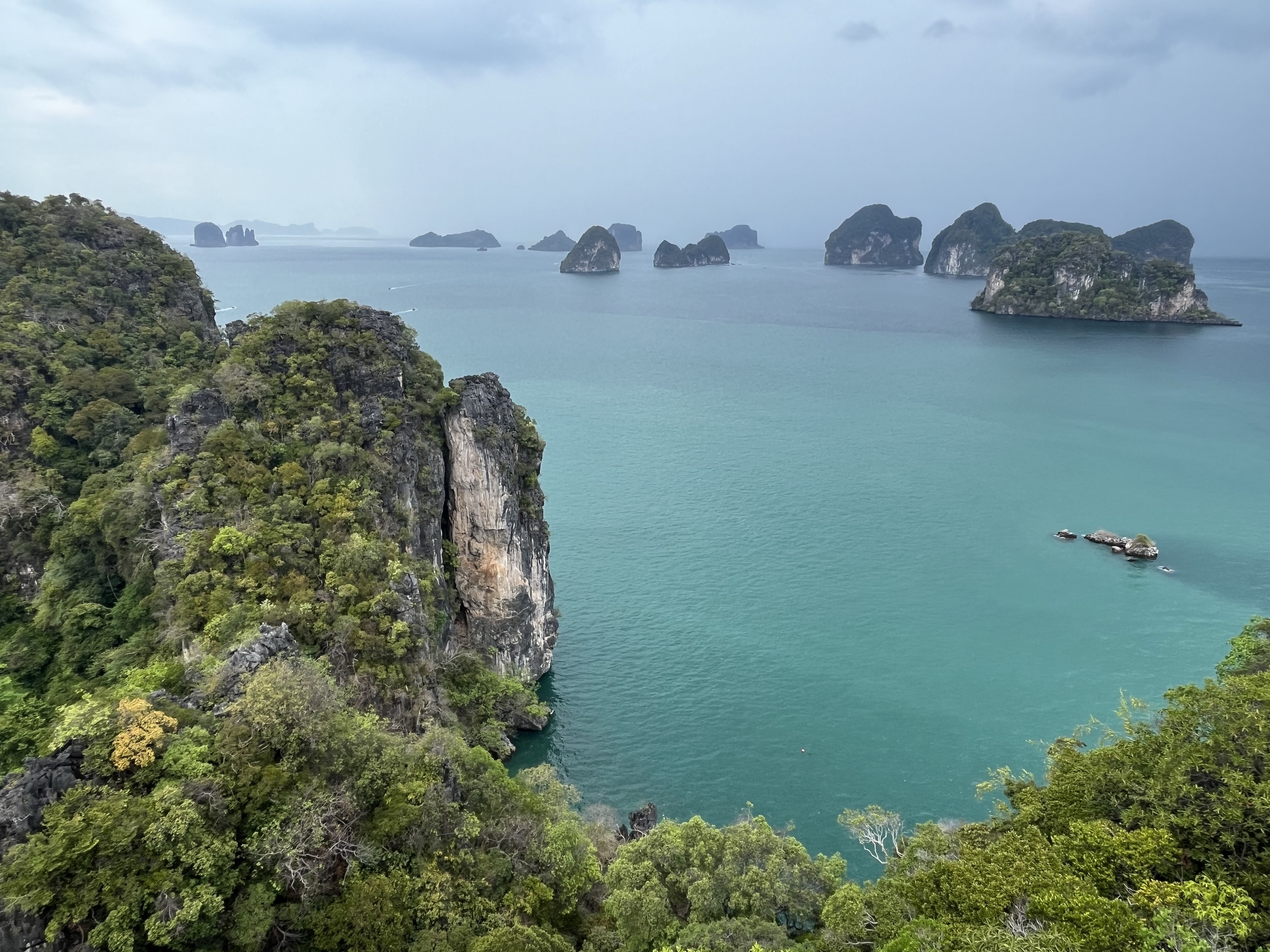
We had a short flight on Air Asia from Kuala Lumpur to Krabi, a city in the south of Thailand – arriving in the afternoon. We booked three nights at a small resort called Le Passe-Temps which is right on the eastern shore of Phang Nga Bay. It was a very convenient location for us to explore the bay, which is an iconic Thai national park that features amazing karst islands, mountains and caves. Last year when we stayed in nearby Phuket, we enjoyed our resort so much that we never left it to explore the bay. So this year, we wanted to make sure we did not miss it. We were picked up at the airport by a retired police man then welcomed to the resort with a refreshing cold tea made with fragrant butterfly pea, a local plant we discovered last year. It was good to be back in Thailand!


Our resort had a good view of the bay and some of its many islands. It also had a nice small beach, but it was a bit rocky at low tide. Our bungalow was one of nine, built in a cute traditional Thai manner, with a small living room featuring a giant Buddha. There weren’t many guests during our stay, so we kind of had the resort to ourselves. The resort arranged all our excursions, transportation and provided our meals – so it was very convenient for us. And it was located just a few minutes away from the village where our outings launched from.


On a side note, this resort makes a conscious effort to employ people from the nearby village, which we really liked. You probably have heard of the disaster that occurred on December 26, 2004 – the day of the most powerful earthquake ever recorded in Asia with a magnitude of 9.1. A massive tsunami with waves up to 30 m (100 ft) high devastated communities along the surrounding coasts of the Indian Ocean, killing an estimated 227,898 people in 14 countries. The people living in the Phang Nga Bay area were hit hard by the tsunami and despite some international aid their incomes are still instable.
Our first excursion was a private boat tour of some of the nearby islands. The hotel provided us a picnic lunch and drove us to the dock in the back of a little truck. Our boat, named Smile, was a flat bottomed shallow wooden draft boat – much like the iconic Thai long tail boats. But this one had an inboard engine instead of the precarious outboard ones. Those are basically gutted car engines mounted on the back of the boat with a very long axle with a propeller at the end. Most of them were loud and smelly as they lacked exhaust systems.


Our captain was a former local fisherman who didn’t speak English, but knew the bay like the back of his hand. He brought us to some of the most picturesque spots on 3 islands. We stopped at a few beaches, hidden coves, went by an island inhabited by crab-eating monkeys, and climbed to the top of the 360 degree view point on Koh Hong island.


We had brought snorkel gear with us, but decided that snorkeling was a bad idea when we saw the incredible amount of jellyfish in the water. Some were bigger than basketballs, and we did not want to get stung. The locals said they had never seen so many jellyfish before, and told us it might have something to do with climate change. You can see the pink and white blobs in our pictures. The jellyfish also washed up all over the beaches as the tide went out and you had to be careful where you walked. I did swim a little though in a very protected bay on Koh Hong Island. The only access to the bay was through a narrow canyon, so it was really neat. There were still a few jellyfish there, but they seemed easier to avoid. Sophie opted out as she had been stung by a jellyfish in Australia and did not want to risk another encounter.


The next morning, we started the day next to our giant Buddha having a little coffee and some chocolate to celebrate Easter. Then we had an amazing kayaking experience! This was one of the highlights of the trip for me. We went back to the village by truck to get to the kayak outfitters where we met our guide.


We started by crossing a little bay to reach some large cliffs that rose vertically out of the water. We navigated around them to a little cove called Monkey Beach. The small beach was surrounded by steep, forested cliffs where monkeys lived. During high tide, it is a pretty little beach and the monkeys are high up in the mountain, so we were not able to spot them there. During low tide, the muddy sea floor exposes small crabs which the monkeys come down to feast on. They have a pretty nice life with brilliant surroundings.


We left the beach, heading to another cliff where there was a small gap that we navigated between. On the other side, we found ourselves in an incredibly steep, narrow canyon that was perfect for kayaking. We started our trip one hour before high tide, so the water was still rushing in the canyon helping to propel us along with little effort. Trees, ferns and other flora lined both sides of the cliffs. There were caves and rock formations here and there.


We wound through this canyon for a long time before coming to a mangrove forest. It was dark and shady there – and if we hadn’t had a guide we would have been lost for sure. We went around and under limbs and roots. In one spot we saw a couple monkeys sitting on a tree grooming each other. In another spot, we entered another little cove that was deep in the mountain. A very large palm tree was growing on one side there and it was green and lush all around. It was hard to capture how it looked with a camera as you were surrounded by the cove on all sides except for the narrow passage in. After 6 kilometers (3.7 miles) and two hours of kayaking, we finally made our way through the mangroves and canyons to the other side.
We had basically made a large loop and ended up back at the bay opposite of our starting spot. What a fun experience – and it was easy kayaking even for beginners like us. However, we would have never made it without a guide. And the mangrove forest was not a place you wanted to get stuck in at low tide! The ground is then covered in thick muck that would have been almost impossible to walk through.


Once back at the resort, we enjoyed the sunset views one more time before heading to the beach. Their restaurant Le bac à sable (The sandbox) was at the edge of the beach. During our stay, we tried different Thai dishes at dinner. The fixed menu always had a type of chicken curry (green, yellow, red) accompanied by rice, an appetizer, another chicken dish, a salad and a dessert.


We checked out after breakfast on our final day, and the resort provided us a ride to our next destination in Phuket, the Sala hotel on Mai Khao beach – about two hours away.
Leave a Reply