
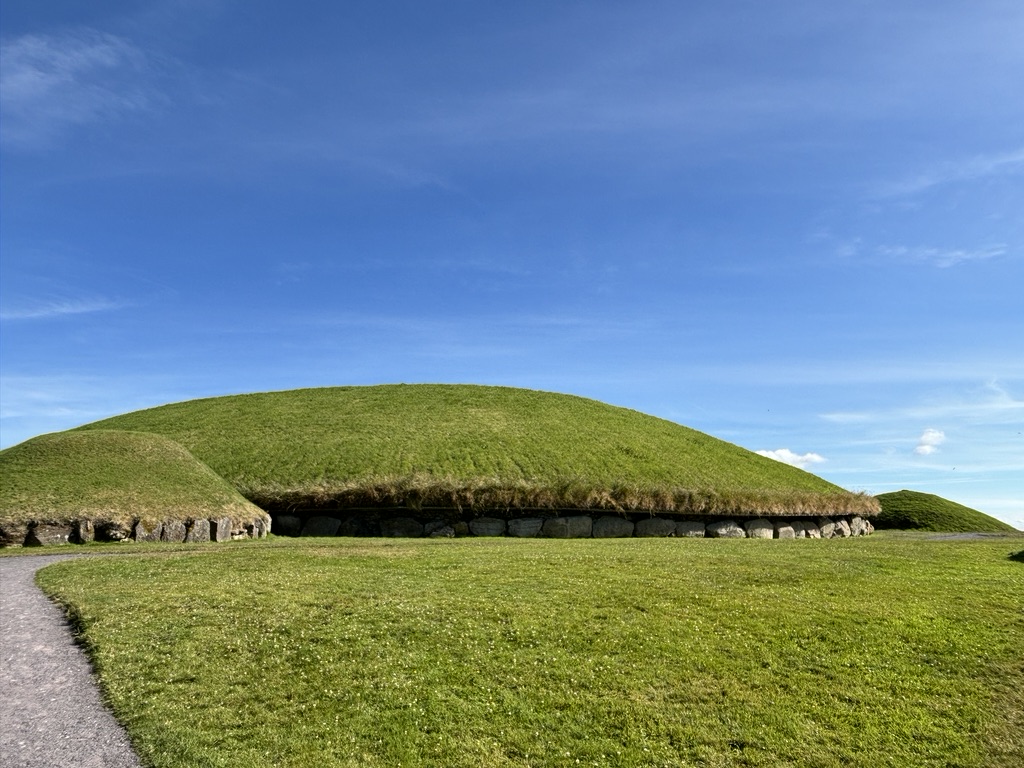
The Boyne Valley is a heritage-rich area of Ireland just north of Dublin. We camped under the shadow of the Loughcrew Cairns on our first night there. The Loughcrew Cairns are a group of 30 mounded passage tombs and one of the most important prehistoric cemeteries in Ireland, perched high atop several hills. Dating from 3200BC, the tombs are older than the pyramids of Egypt and boast some of Europe’s finest megalithic carved stone art. After we settled into our quaint little campground (complete with historic thatched-roof cottages), we hiked to the top of a nearby hill to explore the tombs more closely.


The views from the hill were as majestic as the mounds. You could see for miles in all directions. And the mounds were so interesting – especially the passages that connected the tomb in the center with the outside. These passages were aligned perfectly with either an equinox or solstice so the sun would light up the tomb at sunrise. There were interesting carvings on the large stones in one of the passages. We couldn’t enter the passages (there were locked gates in front), but we could peak inside. It was really picturesque and peaceful to explore these wonders as the summer sun set low on the horizon.


The next day we headed to the town of Trim, home to Ireland’s largest Anglo-Norman castle. Built in 1172, the castle was featured in the 1995 movie “Braveheart”. We arrived just in time to get a tour inside and hear about its amazing history. Situated on elevated ground overlooking a crossing point of the River Boyne, Trim Castle had a very strategic location and was a symbol of Norman authority over the native Irish. One of the castle’s defining features is a massive keep, successfully designed to withstand sieges. Trim was a nice stop and we enjoyed a quick stroll in its picturesque streets.


Our next destination was the UNESCO World Heritage site of Brú na Bóinne – meaning the Palace of the Boyne – which features over 150 neolithic monuments and the passage tombs of Newgrange, Knowth and Dowth. Neolithic means “new Stone Age”, and refers to the era when humans moved from hunter-gathering to farming and started to live in settled groups. In Ireland, it began around 4000 BC and lasted about 1,500 years. As opposed to the Loughcrew tombs we visited the day before on our own, the Brú na Bóinne tombs are more popular and we had to reserve a tour spot well in advance, as that is the only way to visit these sites. Our visit started at a museum where we learned a lot more about the passage tombs. These were built and modified in stages over hundreds of years. The mounds were typically ringed with giant stones. These stones were transported from quarries up to 50 miles away. Many of the stones were also carved with intricate designs. The tomb we visited, Knowth, was unique in that it had different patterns on each rock that circumnavigated the mound. We were lucky with the weather – and the fact that the late-afternoon sun was giving us some good lighting to view the relief carvings on some of the stones. Each pattern or design may have had some meaning, which no one today really knows. Some designs were spirals, some had wavy lines, some were all circles – all were very interesting and decorative.


The passage part of Knowth was not open for tours, but we were able to walk to the top of the mound. It was much bigger than we realized, and there was once a little settlement built on top of it. In the museum we had seen an aerial picture, which helped us comprehend the scale of this amazing site. The panoramic views were stunning from up there and we could see all around the Boyne Valley and beyond.


We spent our final night in Ireland camping on a beach just north of Dublin. It was cool and windy, but a nice sunset bid us farewell. The next morning we drove to the airport to return our camper and catch our flight home.


Travel Tip: All flights to the U.S. from the Dublin airport pass U.S. immigration and passport control before you go to your gate. We have been through there twice, and it is so easy and convenient. No long lines, and we arrived at a domestic gate in Minneapolis!
Ireland grew on us over time despite the cool and rainy summer weather. We quickly learned to always carry raincoat, umbrella and sunglasses! Our camping adventure was a good one and we look back on our days there with more and more appreciation for Ireland’s natural wonders, historical sites and lush green landscapes. It truly earned its nickname of the Emerald Isle!


Leave a Reply