
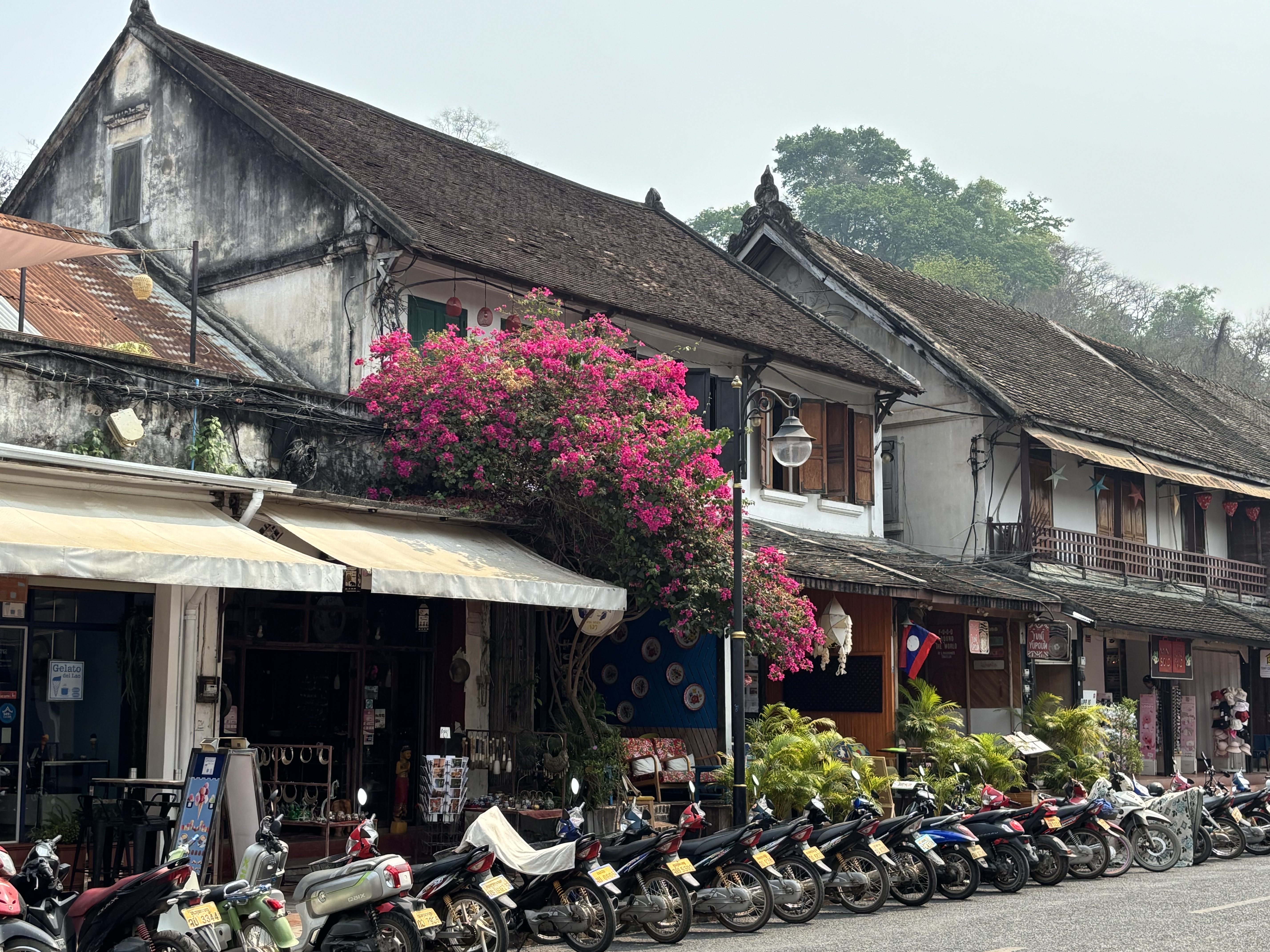
We left Siem Reap, Cambodia, and flew Vietnam Airlines to Luang Prabang, Laos. This was our first time visiting Laos, recently ranked the least expensive country in the world to be a tourist by a considerable margin. When we arrived in Luang Prabang, a city located in north central Laos, we were prepared to see a gritty undeveloped place. On the contrary, we found Luang Prabang to be quite developed and a very lovely city.


It was the capital city of Laos until 1975, and became a UNESCO world heritage site in 1995. With this designation usually comes funding for restoration and preservation work. The city is recognized for blending traditional Lao architecture, European colonial buildings, and over 30 Buddhist temples. There were nice roads and brick sidewalks, beautiful tropical colonial buildings, lots of flowering trees and shrubs, and a robust hotel and restaurant scene.


We spent three nights at The Belle Rive Boutique Hotel, a group of colonial houses with nice balconies, plantation shutters and a view of the Mekong river across the street. According to their website, the hotel opened in 2009 after a group of German friends sailed down the Mekong from Thailand and fell in love with Luang Prabang. One of the friends stayed to look for a perfect place to build a boutique hotel along the Mekong River, and since then three UNESCO protected houses have been renovated to become the hotel.
The hotel owned the land along the bank of the Mekong, where they had a terraced restaurant, lounge areas, a pétanque court (a nod to the French), a large vegetable garden supplying ingredients for their restaurant, and five boats they used to give tours to their customers. We enjoyed watching the boats go by on the Mekong while having breakfast there every morning.


On our first day in Luang Prabang, we walked through the old town, and visited some of the many Buddhist temples (called wats) Luang Prabang is known for. The architecture of the temples was very unique for South East Asia, with tiered rooflines that flared out at the ends. Most had elaborately carved gold doors on the inside, and many had wonderful mosaic stories on their walls. We saw many precious Buddha statues inside the wats. Some of the temples were built as early as the 15th century, others were more modern. A lot of them had been damaged in the recent wars Laos found itself in, so they had been renovated – or were still in the process of being restored.


The first temple we visited was the stupendous Wat Xieng Thong. It is one of the most important Lao monasteries and one of the largest temples in Luang Prabang. Its structure has characteristics of 16th-century Lao architecture, with elaborate mosaic patterns and wall carvings. Every building in the complex was so unique and beautiful!


We passed by a few other wats on our way to the Wat Mai Suwannaphumaham. It is the largest and one of the city’s most fantastic monasteries, built over 70 years in the 18th century.


We also really liked Wat Visounarat, the oldest surviving Buddhist place of worship in the city, founded in 1512. It houses an impressive collection of Buddhas, especially the 17th and 18th century wooden Buddhas in the “Calling for the Rain” posture distinctive to Luang Prabang – with both hands down at the Buddha’s side. The “Calling for the Rain” mudra is believed to have originated when there was a drought with little water to cultivate the fields and the Buddha used his powers to ask the gods for rain so people would have enough food.


Right next to Wat Visounarat was Wat Aham and its two banyan trees said to house the spirit of the guardian deities of Luang Prabang. We also visited the Luang Prabang National Museum, housed in the former Royal Palace erected in 1904 during French colonial era for King Sisavang Vong and his family. It was the royal residence until 1971.
We were really impressed by the very unique and beautiful mural mosaics adorning the walls, depicting traditional Lao lifestyles. It also houses the sacred Prabang Buddha statue, a national treasure. According to legend, The Prabang was cast in Sri Lanka in the 1st century AD. It came to Laos as a gift from the King of Khmer to Fa Ngum, the King of Làn Xang kingdom in 1359. Luang Prabang was originally called Muong Sua Xiang Dong- Xiang Thong. Thankfully, in 1560 they renamed it Luang Prabang in honor of the Prabang image. We were not allowed to take any picture inside the museum.


At the end of the afternoon, we took a complimentary sunset boat cruise arranged by our hotel. The boats there are so much different than the boats we experienced in Thailand and Vietnam. They are very long, narrow and shallow – well-adapted for moving cargo and people up and down this part of the Mekong river.
We happened to be in Laos in April towards the end of their dry season, and it had not rained for a long time. Many trees on the hillsides had lost their leaves and the ground was dry and dusty. We also noticed a permanent haze in the air. Our cruise guide explained that the haze was smoke from cumulative fires the rural folks use to clear the hillsides – in order to grow more lucrative crops like bananas, vegetables and rice. These fires can only be set during the dry season, and the month of April is the smokiest one. This was an unknown fact to us when we were in the planning phase of our trip, and we wished we could have seen the surrounding areas under other circumstances.
There was still a beauty to the landscape though, but one could imagine how different it would have looked when everything was green and lush, and the sky was clear. We were expecting to see a more polluted river after our previous experiences downstream in Vietnam, but the Mekong here was pleasantly clean. We enjoyed our cruise and got to witness an interesting red sunset while chatting with fellow international travelers on board.


We ended the day by sampling some local Lao cuisine at the Bamboo Garden, a restaurant recommended by our hotel. The yellow Curry and the Laab (salad of minced meat) were very tasty, all accompanied with rice of course. On our way back to our hotel, we walked through the night market, filled with beautiful handicrafts made by the local Hmong tribes, it was a great first day in Laos!


On our second day, we ventured out of town for some fun experiences at a rice farm and a famous waterfall, which we will write about in our next post.
On our last morning in Luang Prabang, we woke up early to watch the Tak Bat ceremony, which is when the monks get their alms. There are hundreds of monks studying and living in the many temples in town, and it is tradition that every morning at sunrise they walk through the streets with covered bowls collecting their food for the day.
Lay Buddhists believe they accumulate “merit” or good karma by giving food to the monks. The lay people sit on low stools (so they are lower than the monks) and put a little clump of sticky rice into each bowl as the monks pass. This is the primary source of food for the monks and sticky rice is a staple eaten at every meal in Laos. It was a very unique experience and we were glad to be able to witness it before leaving town.


We borrowed bikes from our hotel later in the morning to explore the city a bit more, and to climb a sacred hill in the middle of town called Mount Phou Si, right across from the National Museum. We made our way to the top, climbing some 328 steps. Again, the views would have been better had it not been so smokey. We followed a different path to come down and went by various Buddhas, a Buddha’s footprint, and some shrines in little caves.


We enjoyed our bike ride and found the city of Luang Prabang really easy to get around – most of it is walkable. Traffic is light, there are lots of trees to make shade, and the architecture and decor all around is quaint. We were really impressed by Luang Prabang!


Traveling by road takes a really long time in Laos because most of them are in poor shape. But China recently built a high speed train line, which has greatly improved the ability to reach cities. We left Luang Prabang after lunch by train headed to our next destination, the city of Vang Vieng.


Leave a Reply